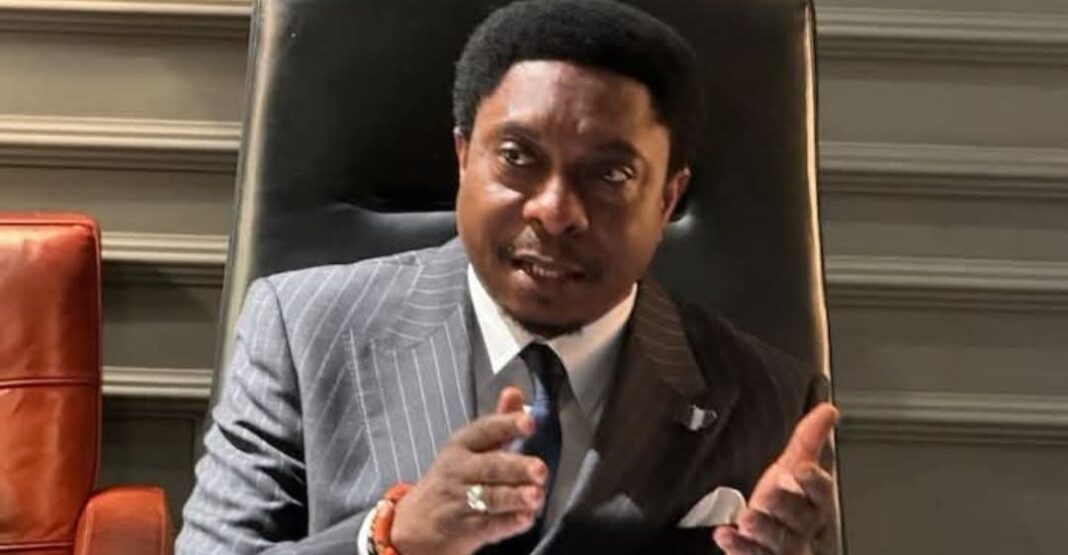

ANOSIKE PRAISES TINUBU’S SUBSIDY REFORM, BUT NIGERIANS NOW WANT TO KNOW: WHERE ARE THE BILLIONS GOING?
The debate over President Bola Ahmed Tinubu’s removal of the petrol subsidy has entered another phase, and this time, an opposition politician is making an argument that deserves serious attention.
Dr Kelechi Anosike, the Peoples Democratic Party (PDP) governorship candidate in Abia State for the 2027 election, has backed President Tinubu for a second term, arguing that the removal of the petrol subsidy has increased the resources available to governments, improved public finances and created more room for infrastructure and development.
That position is politically significant because Anosike is not an APC candidate. He is a PDP candidate seeking to govern Abia State.
His argument is simple: if subsidy removal has put substantially more money into the hands of governments, then Nigerians must begin asking what state governments are doing with the additional resources.
That question is difficult to dismiss.
But it is also important to get the facts right.
The increase in Federation Account Allocation Committee (FAAC) distributions after the subsidy reform cannot simply be described as “subsidy money.” FAAC revenue comes from different sources, including oil revenue, VAT, statutory revenue, exchange-related gains and other federally collected revenues.
The removal of the petrol subsidy was, however, one of the major changes that altered Nigeria’s fiscal situation.
And the numbers show that the amount being shared by the three tiers of government increased significantly.
In May 2023, shortly before the subsidy removal, FAAC distributed about ₦976.34 billion to the federal, state and local governments.
By April 2024, the monthly distribution had climbed to about ₦1.87 trillion.
By June 2024, the distribution reached about ₦2.32 trillion.
That is not a small change.
It represents a major shift in the amount of money flowing through Nigeria’s public finance system.
The National Extractive Industries Transparency Initiative (NEITI) later reported that FAAC distributed ₦15.26 trillion to the three tiers of government in 2024, a 43 per cent increase over the previous year.
States also received substantially more money.
Reported FAAC figures put the combined allocation to the 36 states and the Federal Capital Territory at about ₦5.38 trillion in 2024, compared with approximately ₦3.92 trillion in 2023.
That is roughly ₦1.46 trillion more.
So the question is not whether governments received more money.
They did.
The real question is what happened to that money.
How much went into salaries?
How much went into pensions?
How much went into roads?
How much went into hospitals?
How much went into schools?
How much went into security?
How much went into agriculture?
How much went into debt repayment?
How much went into capital projects?
How much went to local governments?
How much was saved?
And, most importantly, how much can ordinary Nigerians point to and say: “This is what the additional money has done for us”?
This is where the debate should move.
For years, Nigerians heard that the subsidy system was consuming huge amounts of public money and making government finances difficult to manage.
The subsidy was removed.
The amount being distributed through FAAC increased sharply.
But increased government revenue does not automatically mean increased development.
Money entering a state government account is not the same as money reaching the people.
That distinction is at the heart of the current argument.
Anosike has reportedly argued that before the subsidy reform, some states struggled to pay salaries and pensions and depended heavily on bank borrowing. He has also argued that the increased resources should now translate into welfare and development.
If that is the case, then every governor should be prepared to answer the same question.
What did you do with the additional money?
The question should not be treated as an attack on any particular political party.
It should be a national accountability question.
A governor cannot simply celebrate a larger monthly allocation.
Citizens should want to know what the larger allocation produced.
A state that receives more money but still has terrible roads, weak hospitals, poor schools, high unemployment and a weak economy cannot simply point to the size of its FAAC allocation as an achievement.
The achievement is what the money produces.
There is another uncomfortable issue.
Many Nigerian states remain heavily dependent on federal allocations.
BudgIT’s State of States analysis has shown the extent of this dependence, with many states relying on FAAC for a very large share of their total revenue.
That means the real challenge is not only how much money governors receive from Abuja.
It is whether they are using that money to build economies capable of generating sustainable revenue.
Why should a state with millions of people and significant economic activity remain permanently dependent on federal allocation?
Why should a governor celebrate receiving more FAAC without explaining how the state will increase its own internally generated revenue?
What happens when oil prices fall?
What happens when oil production declines?
What happens when exchange-related gains reduce?
What happens when federal revenue drops?
These are not imaginary questions.
Nigeria has seen this cycle before.
Oil revenue increases.
Government spending increases.
Allocations increase.
Governments expand their budgets.
Then oil prices fall or production declines.
Revenue drops.
Governments borrow.
Salaries become difficult to pay.
Projects are abandoned.
The cycle starts again.
The purpose of economic reform should therefore be bigger than simply increasing monthly allocations.
States should use the current fiscal opportunity to build productive economies.
Agriculture.
Manufacturing.
Technology.
Mining.
Tourism.
Small businesses.
Industrial development.
Power.
Transport.
Education.
Healthcare.
Those are the sectors that can create jobs and expand the tax base.
A governor who receives billions every month but leaves the state dependent on those same billions has not solved the fundamental problem.
The state is still vulnerable.
The Abia question is particularly interesting because Anosike is entering the 2027 election as a PDP candidate while openly praising an important economic policy of the APC-led Federal Government.
That shows that some Nigerians are beginning to separate economic policies from party politics.
But if Anosike believes subsidy reform has created a new opportunity for states, Abia voters should demand details from him.
How much will Abia receive from FAAC?
How much will be generated through IGR?
How much will go to salaries?
How much to pensions?
How much to roads?
How much to healthcare?
How much to education?
How much to security?
How much to local governments?
How much to debt servicing?
How much to capital projects?
And how much will his administration save?
Those questions should not be answered with campaign slogans.
They should be answered with numbers.
The same questions should be put to every governorship candidate across Nigeria.
The 2027 election should not only be about who supports President Tinubu and who opposes him.
It should be about what candidates intend to do with public money.
The Federal Government has responsibilities.
State governments have responsibilities.
Local governments also have responsibilities.
Not every bad road in Nigeria is the responsibility of the President.
Not every failed hospital is Abuja’s responsibility.
Not every abandoned school is the Federal Government’s responsibility.
Governors control state budgets and determine many of their states’ priorities.
They award contracts.
They prepare budgets.
They determine how much goes into different sectors.
They are therefore directly accountable to their people.
This does not mean President Tinubu should escape scrutiny.
Far from it.
The President introduced the subsidy removal policy and therefore owns the consequences of the decision.
His administration deserves credit if the reform has strengthened government finances.
But it must also accept criticism over the hardship Nigerians have experienced.
The removal of subsidy contributed to a huge increase in petrol prices and placed additional pressure on transport, food and household expenses.
A government cannot simply say that public revenue has improved while ignoring the pressure being felt by ordinary citizens.
Both realities can exist at the same time.
The reform can improve government finances while making life harder for households in the short term.
It can increase FAAC distributions while increasing transport fares.
It can reduce a major government expense while increasing the cost of living.
That is why the real test is not whether more money is available.
The real test is whether that money is being turned into better lives.
And this is where state governors must answer.
If allocations increase but roads remain bad, governors must explain.
If allocations increase but public hospitals remain poorly equipped, governors must explain.
If allocations increase but schools remain in poor condition, governors must explain.
If allocations increase but workers remain unpaid, governors must explain.
If allocations increase but poverty remains high, governors must explain.
If allocations increase but states continue borrowing heavily, governors must explain.
There should be no mysterious government money.
Every major allocation should be traceable.
Every special fund should be traceable.
Every loan should be traceable.
Every major contract should be traceable.
Every completed project should be independently verifiable.
If a state receives money for roads, citizens should know the amount.
If a state receives money for healthcare, citizens should know where it went.
If a state receives an intervention fund, the public should know the purpose and beneficiaries.
That is not asking for too much.
It is basic accountability.
Nigeria cannot continue with a system where politicians announce billions while citizens struggle to see the result.
Politicians talk about budgets.
Citizens experience roads.
Politicians talk about allocations.
Citizens experience hospitals.
Politicians talk about development.
Citizens experience schools.
Politicians talk about billions.
Citizens ask where the money went.
That gap between government announcements and people’s daily experience is one of the biggest problems in Nigerian governance.
This is why Anosike’s argument should not end with praise for President Tinubu.
It should lead directly to the offices of state governors.
If subsidy removal has genuinely created more fiscal space, then Nigerians should see the benefit.
The government does not need to convince Nigerians with political speeches.
The roads should speak.
The hospitals should speak.
The schools should speak.
The factories should speak.
The jobs should speak.
The improved economy should speak.
The standard of living should speak.
That is how citizens will know whether the billions are being properly used.
There is also a need to correct the idea that every naira distributed through FAAC after subsidy removal came from subsidy savings.
That would be misleading.
FAAC revenue comes from different sources, including statutory revenue, oil revenue, VAT, exchange gains and other government receipts.
Changes in the foreign exchange market also affected the naira value of some government revenues.
Oil production and prices also matter.
Tax collection matters.
VAT matters.
Therefore, the fiscal increase cannot honestly be credited to subsidy removal alone.
But that does not weaken the bigger question.
The money available to governments increased substantially.
Governors must account for it.
There is also the issue of borrowing.
Claims that states no longer need to borrow because of higher FAAC must be treated carefully.
State debt data shows that some states have continued to borrow even after the increase in federal allocations.
That means the situation is different from state to state.
Some states may have improved their finances.
Others remain under pressure.
Therefore, Nigerians should stop discussing state finances only in general terms.
Every state should be examined separately.
Every governor should be judged by the numbers of his or her own state.
What was the state’s FAAC allocation before the subsidy removal?
What is it now?
What was the IGR before?
What is it now?
What was the debt before?
What is it now?
What was capital expenditure before?
What is it now?
What projects were completed?
What projects remain abandoned?
Those figures will tell Nigerians more than political propaganda.
And this is where the 2027 election becomes important.
The next election should be a referendum on performance.
Candidates should publish their fiscal plans.
They should explain how they will spend FAAC.
They should explain how they will increase IGR.
They should explain how they will reduce waste.
They should explain how they will attract investors.
They should explain how they will create jobs.
They should explain how they will improve healthcare.
They should explain how they will fix roads.
They should explain how they will improve schools.
They should explain how they will make their states less dependent on Abuja.
Nigeria cannot continue celebrating money coming into government accounts without asking what happens next.
The country has experienced periods of high revenue before.
The problem has always been turning revenue into lasting development.
The subsidy reform therefore presents both an opportunity and a test.
The opportunity is increased fiscal space.
The test is whether governments can use that space properly.
If the extra money is wasted, Nigerians will have suffered the pain of subsidy removal without receiving the expected benefit.
If the money is invested wisely, the reform could eventually become part of a much bigger economic transformation.
That is why the governors matter.
The President can change national fiscal policy.
But governors determine what much of that money becomes on the ground.
A road.
A hospital.
A school.
A water project.
A farm.
A factory.
A job.
Or another government expenditure that citizens cannot easily identify.
The argument should therefore no longer be simply “Subsidy removal: good or bad?”
The bigger question is:
“After the subsidy removal and the increase in public revenue, what have governments done with the money?”
That is the question Nigerians should be asking in every state.
And politicians should be prepared to answer.
Not with posters.
Not with slogans.
Not with political attacks.
With figures.
With projects.
With evidence.
With results.
Because public money is not the personal property of any governor, minister or president.
It belongs to the people.
Governments are only custodians.
And when the people give government more money, they have every right to demand more results.
So Anosike may have opened an important political conversation by praising Tinubu’s subsidy reform.
But the conversation should go much further.
It should reach every Government House in Nigeria.
It should reach every state budget.
It should reach every local government.
It should reach every major government contract.
And ultimately, it should reach the ordinary Nigerian who is still asking the most important question of all:
AFTER ALL THESE BILLIONS HAVE BEEN SHARED, WHERE EXACTLY IS THE MONEY GOING?