Former Edo Assembly Speaker says his resignation was voluntary, documented and publicly announced, dismisses social media reports claiming he was removed from office
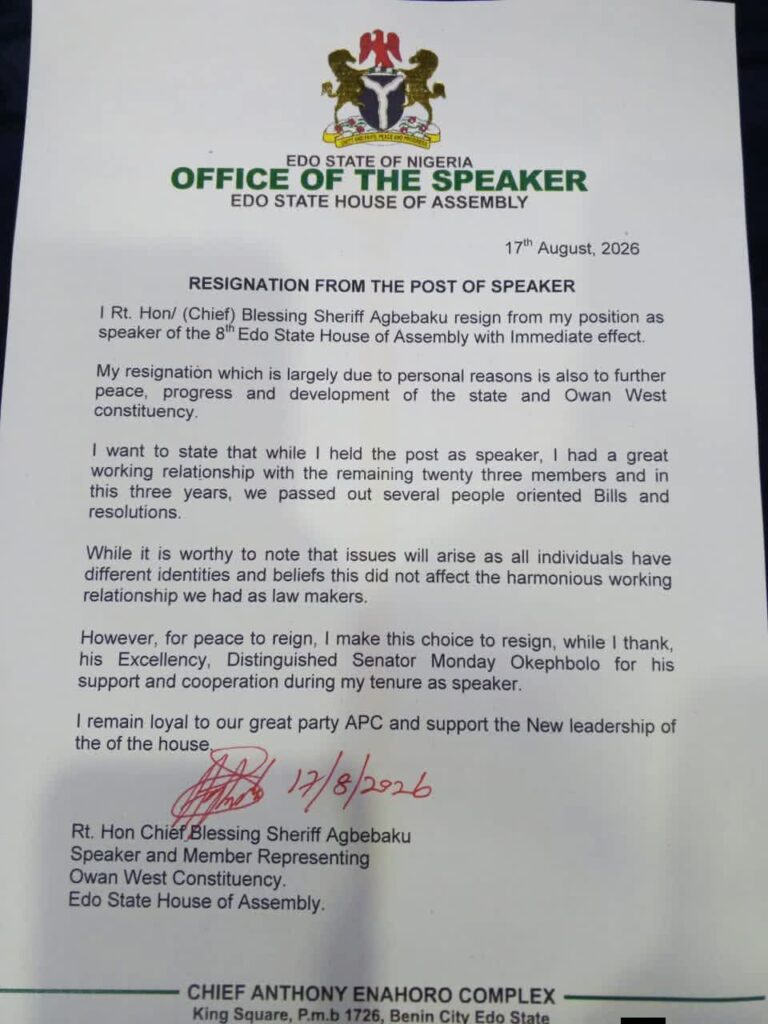
Former Speaker of the Edo State House of Assembly, Rt. Hon. Chief Blessing Sherriff Agbebaku, has rejected reports suggesting that he was impeached from office, insisting that he voluntarily resigned as Speaker on August 17, 2026.
Agbebaku made the clarification in a statement issued to set the record straight over what he described as attempts on social media to rewrite the circumstances surrounding his departure from the speakership.
According to him, he personally tendered his resignation on the floor of the Edo State House of Assembly on August 17 and formally submitted a signed resignation letter stating that he was resigning from his position as Speaker with immediate effect.
He explained that the resignation letter was personally handed over to Hon. Ojeizele Sunny, who subsequently presented it to the Deputy Speaker, Hon. Atu Osawonyi, who was presiding over the sitting at the time.
Agbebaku said his resignation was not a secret arrangement or an undocumented political development, stressing that he also personally addressed lawmakers during plenary and publicly announced his decision to leave the position.
He further pointed out that the proceedings were covered by television stations and other media organisations, with video footage of his appearance and address before the House still available.
“I WAS NOT IMPEACHED. I RESIGNED,” Agbebaku declared.
The former Speaker said he was therefore surprised by social media reports portraying his resignation as an impeachment.
He argued that resignation and impeachment are fundamentally different constitutional and parliamentary processes and should not be confused for political reasons.
Agbebaku said his resignation letter dated August 17, 2026, clearly stated: “I… resign from my position as Speaker of the 8th Edo State House of Assembly with immediate effect.”
He maintained that the documentary evidence, plenary proceedings, television reports and video recordings would provide a clear account of what happened.
The controversy comes after Agbebaku stepped down from the speakership and Hon. Yekini Idaiye, representing Akoko-Edo I Constituency, was subsequently elected as the new Speaker of the Edo State House of Assembly.
Reports surrounding the leadership change had indicated that there were moves within the Assembly to remove Agbebaku from office, with political tensions reportedly surrounding the leadership of the House.
However, in his latest statement, Agbebaku is drawing a clear distinction between the reported political pressure surrounding his departure and the formal manner in which he eventually left office.
He said he made the decision to resign consciously and publicly in what he described as the interest of peace, progress and the development of Edo State and his Owan West Constituency.
“I chose to resign in the interest of peace, progress and the development of Edo State and my Owan West Constituency. I made that decision consciously and publicly,” he said.
His statement appears aimed at correcting what he considers a growing misconception about his political status and the circumstances that ended his tenure as Speaker.
Agbebaku also stressed that leaving the speakership did not mean that he had lost his elected position in the Edo State House of Assembly.
He remains the member representing Owan West Constituency and said he remains committed to representing his constituents.
“I remain a duly elected member representing the good people of Owan West Constituency, and I remain committed to providing them with effective representation,” he said.
He also reaffirmed his loyalty to the All Progressives Congress and his commitment to the peace and progress of Edo State.
The former Speaker’s clarification is likely to add another dimension to the political debate surrounding the recent leadership change in the Edo Assembly, particularly in Owan West, where the issue has already generated political reactions.
The development has also renewed discussion about the political balance within Edo North Senatorial District following the emergence of Idaiye, an Akoko-Edo lawmaker, as Speaker.
For Agbebaku, however, the immediate issue is the record of what happened on August 17.
He insists that the historical record should reflect that he resigned rather than being impeached.
“The letter is there.
“The plenary proceedings are there.
“The video of my speech on the floor of the House is there.
“The television reports are there.
“The witnesses are there.
“These are verifiable facts,” he stated.
The distinction is politically important because impeachment carries a different meaning from resignation.
An impeachment is a formal legislative process through which an elected official is removed from office after proceedings within the legislature. A resignation, on the other hand, involves the officeholder voluntarily relinquishing the position.
Agbebaku’s argument is that whatever political developments preceded his departure, the formal act that ended his tenure as Speaker was his own resignation.
He therefore urged the public not to allow political narratives or social media claims to replace documented events.
“For the avoidance of doubt and for the sake of history and posterity: On 17th August 2026, I voluntarily resigned as Speaker of the Edo State House of Assembly. I was not impeached,” he said.
The statement comes at a time when the Edo Assembly is beginning a new chapter under Idaiye, who has pledged a different approach to legislative business and greater focus on lawmaking and oversight.
The new Speaker has also made allegations concerning the former leadership of the House, including claims relating to procurement and the administration of the Assembly. Those allegations remain matters for proper investigation and due process.
Agbebaku’s latest statement does not address those allegations directly. Instead, it focuses on the circumstances of his departure from the speakership and his insistence that the public record should not describe him as an impeached Speaker.
The former Speaker has now placed the issue firmly before the public: whether his departure should be described politically as a removal or, as the official documents and proceedings indicate according to him, a resignation.
For Agbebaku, the answer is clear.
He resigned.
He was not impeached.
And he says the documentary and video evidence is available for anyone who wants to verify the facts.
“FACTS ARE SACRED. HISTORY MUST NOT BE REWRITTEN,” Agbebaku said.