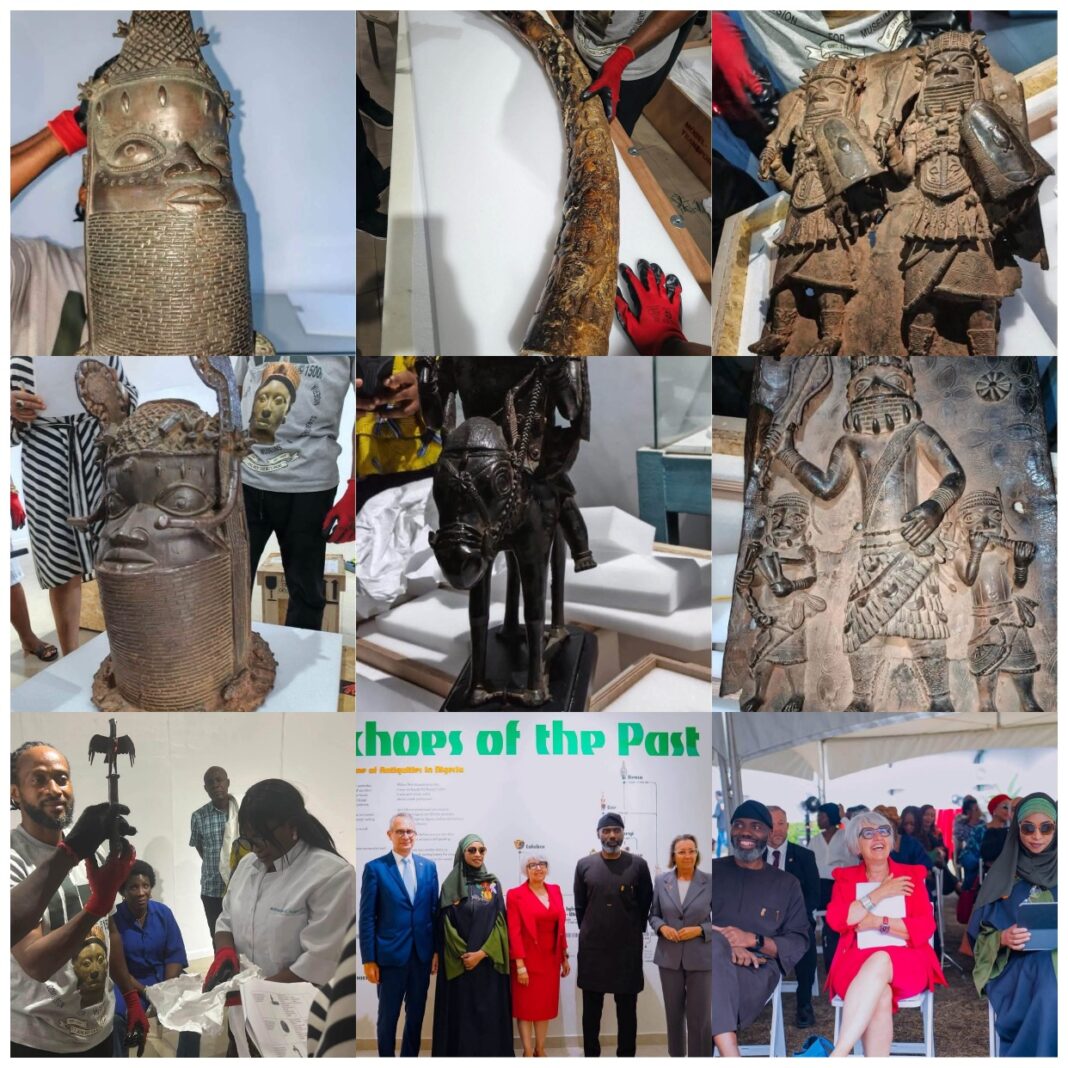

LAGOS, NIGERIA — Nigeria has recorded another major breakthrough in its campaign for the repatriation of stolen cultural heritage, receiving 22 artefacts from Switzerland, including 18 Benin Bronzes and four Ikom Monoliths.
The historic handover took place at the National Museum in Lagos during a ceremony that also witnessed the signing of a bilateral agreement between Nigeria and Switzerland on the protection and regulation of cultural property.
Nigeria’s Minister of Art, Culture, Tourism and Creative Economy, Hannatu Musawa, signed the agreement on behalf of the Federal Government, while Swiss Minister for Culture, Elisabeth Baume-Schneider, signed on behalf of Switzerland.
The agreement is aimed at regulating the import and export of cultural property in line with the provisions of the 1970 UNESCO Convention, strengthening cooperation between both countries in the fight against illicit trafficking of cultural artefacts.
The returned artefacts include four Ikom Monoliths and 18 Benin Bronzes that had been held in Swiss institutions, including the Museum of Ethnography Geneva, the Ethnographic Museum of the University of Zurich, and Museum Rietberg.
Officials described the development as a significant milestone in Nigeria’s ongoing efforts to recover cultural treasures removed from the country during the colonial era and through illicit trade networks.
The National Commission for Museums and Monuments (NCMM), which coordinated the repatriation process, said the return of the artefacts represents another important step towards restoring Nigeria’s cultural heritage and preserving its historical identity for future generations.
The ceremony also underscored growing international recognition of calls for the restitution of African cultural property and the need for stronger global collaboration in safeguarding heritage assets.
Cultural stakeholders have welcomed the return of the artefacts, describing it as a victory for historical justice and a testament to Nigeria’s sustained diplomatic engagement with international partners.
The recovered items are expected to be preserved and displayed in accordance with national heritage preservation guidelines, allowing Nigerians and visitors alike to reconnect with significant aspects of the country’s cultural history.