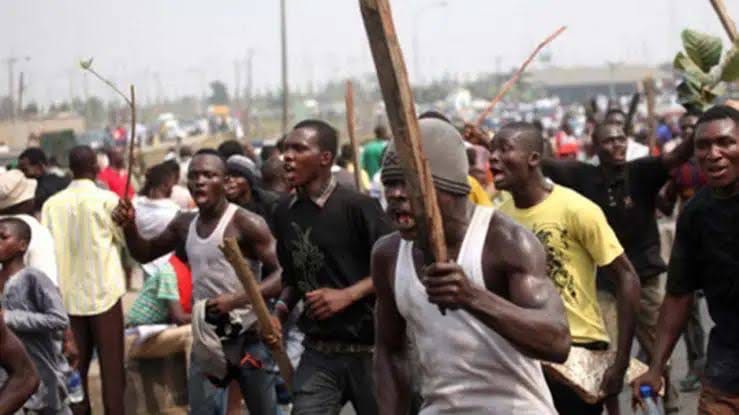

How suspicion, fear and distrust of the justice system continue to turn allegations into deadly mob attacks
By Mukhtar Sagir Dambatta, News Agency of Nigeria (NAN)
ABUJA, Nigeria — In Nigeria, an allegation of theft can sometimes turn a gathering crowd into a violent mob within minutes.
A cry of “Ole!”, “Barawo!”, “Onyeoshi!” or “Thief!” may be enough to draw people towards an accused person before the allegation is properly established.
Sticks, stones and other objects can quickly become weapons, and in some cases the accused is seriously injured or killed before the police arrive.
Known as jungle justice or mob justice, the practice involves crowds taking punishment into their own hands instead of allowing allegations to be investigated and determined through the legal system.
Despite the existence of the police, courts and other institutions responsible for criminal justice, mob attacks continue to occur in different parts of Nigeria.
One of the incidents that brought the issue into sharp national focus was the killing of the “Aluu Four” in Rivers State in 2012.
In October that year, four students of the University of Port Harcourt — Chiadika Biringa, Ugonna Obuzor, Lloyd Toku and Tekena Elkanah — were attacked and killed in Aluu community after being accused of stealing.
They were beaten and set ablaze by a mob, while images of the incident circulated widely and triggered public outrage.
Similar incidents have continued.
In March 2025, 16 travellers were killed by a mob in Uromi, Edo State, after they were accused of being kidnappers. Reports identified the victims as hunters travelling from the South to the North.
President Bola Tinubu condemned the killings and directed security agencies to investigate the incident and prosecute those responsible.
The Uromi killings again highlighted the dangers of allowing suspicion and fear to replace investigation.
In another case, 25-year-old Ibrahim Mbaya, popularly known as “Ibee”, was allegedly attacked by a mob in Jos, Plateau State, on July 26 after being accused of stealing an iPhone 12.
He was later taken to the Jos University Teaching Hospital, where he was confirmed dead.
The Plateau State Police Command subsequently announced the arrest of suspects in connection with the incident.
Police move to treat mob justice as homicide
The Inspector-General of Police, Olatunji Disu, recently directed that cases of jungle justice should be treated as homicide.
The directive has received support from security advocates who say mob attacks undermine the rule of law and can result in the killing of innocent people.
President of the Security Situation Room, Douglas Ogbankwa, described the directive as timely, warning that allowing citizens to use force to resolve suspected criminal activity could lead to anarchy.
“Allowing people to resort to strong-arm tactics in solving criminal activities is an invitation to anarchy,” Ogbankwa said.
He argued that the existence of government is rooted in the social contract between citizens and constituted authorities, adding that allowing individuals to take the law into their own hands undermines that arrangement.
Ogbankwa said the 1999 Constitution and other laws provide lawful mechanisms for resolving disputes and dealing with suspected crimes.
He also pointed to the Police Act 2020, which empowers the police to detect and investigate crimes and arrest suspects within their jurisdiction.
He called for strict enforcement of the police directive and urged individuals to take responsibility for their actions.
Security analyst Ahmed Umar similarly said suspected crimes should be reported to security agencies for investigation rather than punished by crowds.
“Allowing people to take the law into their own hands could result in the killing of innocent people who might later be found not to have committed any offence,” he said.
Legal practitioner Yusuf Aliyu Yusuf stressed that an accusation is not the same as proof of guilt.
He said determining whether a person had committed a crime was the responsibility of institutions established by law.
Community leader Barau Kawu said communities also had a role to play by discouraging rumours and promptly reporting suspected criminal activity to security agencies.
“Community members should avoid taking action based solely on allegations or information received from others,” he said.
Why mob justice persists
There is no reliable national figure for deaths resulting from jungle justice.
Human rights organisations and researchers have documented numerous incidents over the years, but the actual scale remains difficult to determine because some attacks, particularly in remote communities, may never be reported to the police, courts or mainstream media.
Experts identify distrust in law enforcement and the wider justice system as one factor behind mob violence.
Where citizens believe suspects may escape justice or criminal cases may not be effectively handled, some may become inclined to punish accused persons themselves.
Nigeria’s security challenges have also contributed to heightened suspicion in some communities.
Kidnapping, banditry and other violent crimes have affected communities across the country, creating an environment in which unfamiliar people or circumstances can quickly generate suspicion.
But an allegation remains an allegation until it is properly investigated and determined through due process.
Section 33 of the 1999 Constitution protects the right to life, subject to the exceptions provided by the Constitution, while the criminal justice system provides mechanisms for investigating allegations and determining guilt.
A stolen phone may have been misplaced. A misunderstanding may be mistaken for criminal behaviour. A person may also simply be wrongly identified.
Once a mob attack begins, however, there may be little opportunity for the truth to emerge.
Ending jungle justice therefore requires more than condemning individual incidents after they occur. It requires effective investigation, prosecution of perpetrators, public confidence in law enforcement and a clear understanding among citizens that reporting a suspected crime is fundamentally different from punishing a suspect.
For communities, the immediate challenge is to resist acting on rumours and allegations before the facts are established.
When justice is taken into the streets, a mere accusation can become an irreversible death sentence.
Edited by Chijioke Okoronkwo, Felix Ohimai Esezobor