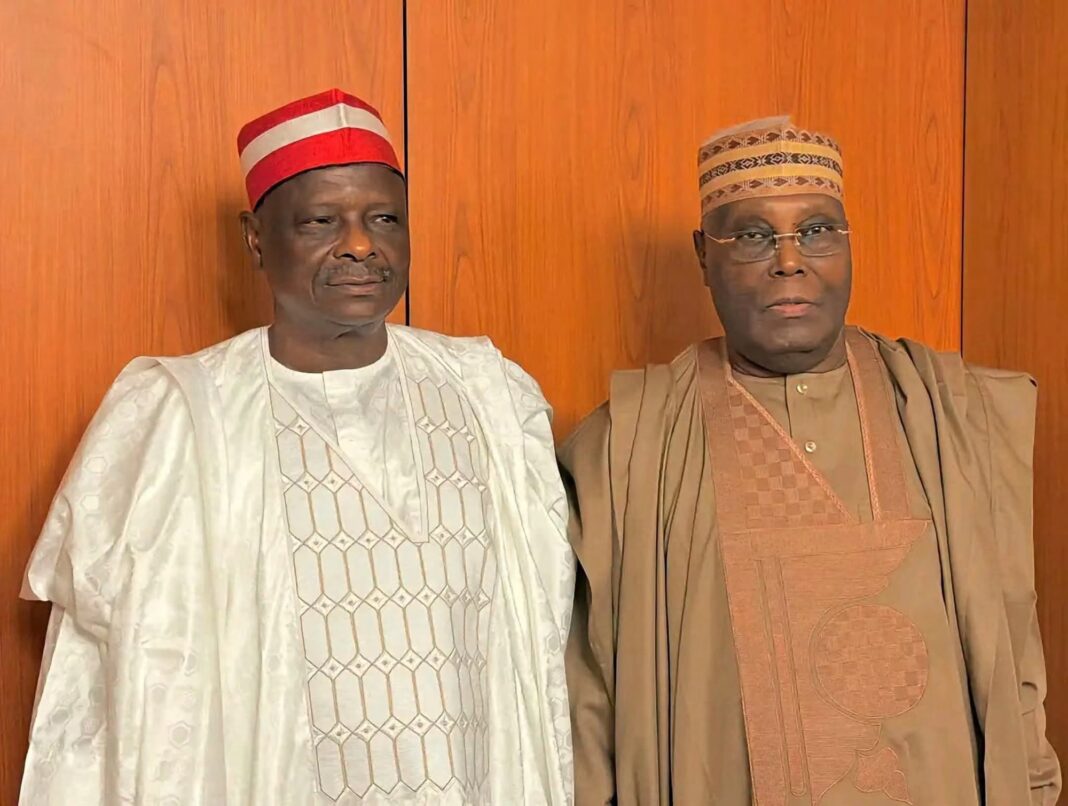

ABUJA, NIGERIA — The African Democratic Congress Presidential Campaign Council (ADC-PCC) has declared that former Vice-President Atiku Abubakar can win Kano State in the 2027 presidential election without the support of former Kano State Governor, Senator Rabiu Musa Kwankwaso.
The council made its position known while responding to Kwankwaso’s call for Atiku to withdraw from the presidential race in favour of Peter Obi, the presidential candidate of the Nigeria Democratic Congress (NDC).
Kwankwaso, who is Obi’s running mate, explained in an interview on Channels Television’s Politics Today that his appeal to Atiku was based partly on their longstanding political relationship and his belief that the former vice-president should step aside to allow a different political arrangement ahead of the 2027 election.
However, the ADC-PCC rejected the suggestion, describing Kwankwaso’s intervention as self-serving and warning that it could deepen divisions among opposition politicians at a time when they should be working towards a common electoral objective.
The council’s Director of Media and Publicity, Kola Ologbondiyan, said opposition leaders should concentrate on challenging President Bola Tinubu and the ruling All Progressives Congress (APC), rather than directing their efforts against one another.
Ologbondiyan accused Kwankwaso of advancing the interests of the ruling party through his call for Atiku to step down. He argued that political disagreements among opposition leaders could weaken their collective efforts ahead of the 2027 general election.
The ADC-PCC spokesman maintained that Kwankwaso’s political influence in Kano should not be regarded as a determining factor in Atiku’s chances in the state.
To support his argument, Ologbondiyan referred to the presidential elections of 2003 and 2007, citing the electoral performances of former President Muhammadu Buhari in Kano as evidence that a presidential candidate could secure support in the state without relying on Kwankwaso.
He also pointed to Atiku’s political relationships across Nigeria’s six geopolitical zones, arguing that the former vice-president had developed a broad national political network over several decades.
The council further questioned Kwankwaso’s national electoral performance in 2023, when he contested the presidency under the New Nigeria Peoples Party (NNPP) and finished fourth in the final results announced by the Independent National Electoral Commission (INEC).
Ologbondiyan also suggested that Kwankwaso’s latest position could be connected to longer-term political calculations beyond the 2027 election. These assertions represent the campaign council’s interpretation of Kwankwaso’s actions and have not been independently established.
Kwankwaso, however, has said his appeal to Atiku was not motivated by hostility. In explaining their political relationship, he traced their dealings to 1993, when both were involved in the political movement led by the late General Shehu Musa Yar’Adua. He also recalled their subsequent political interactions during the transition to civilian rule and later elections.
The disagreement highlights the continuing challenge of opposition coordination ahead of the 2027 presidential election, with Atiku and Obi associated with different political parties and both figures involved in discussions about the direction of the opposition.
While the ADC-PCC insists that Atiku can compete for Kano without Kwankwaso’s backing, the eventual outcome will depend on the candidates, party organisation, campaign strategies and decisions made by voters when the election is held.
IBN News