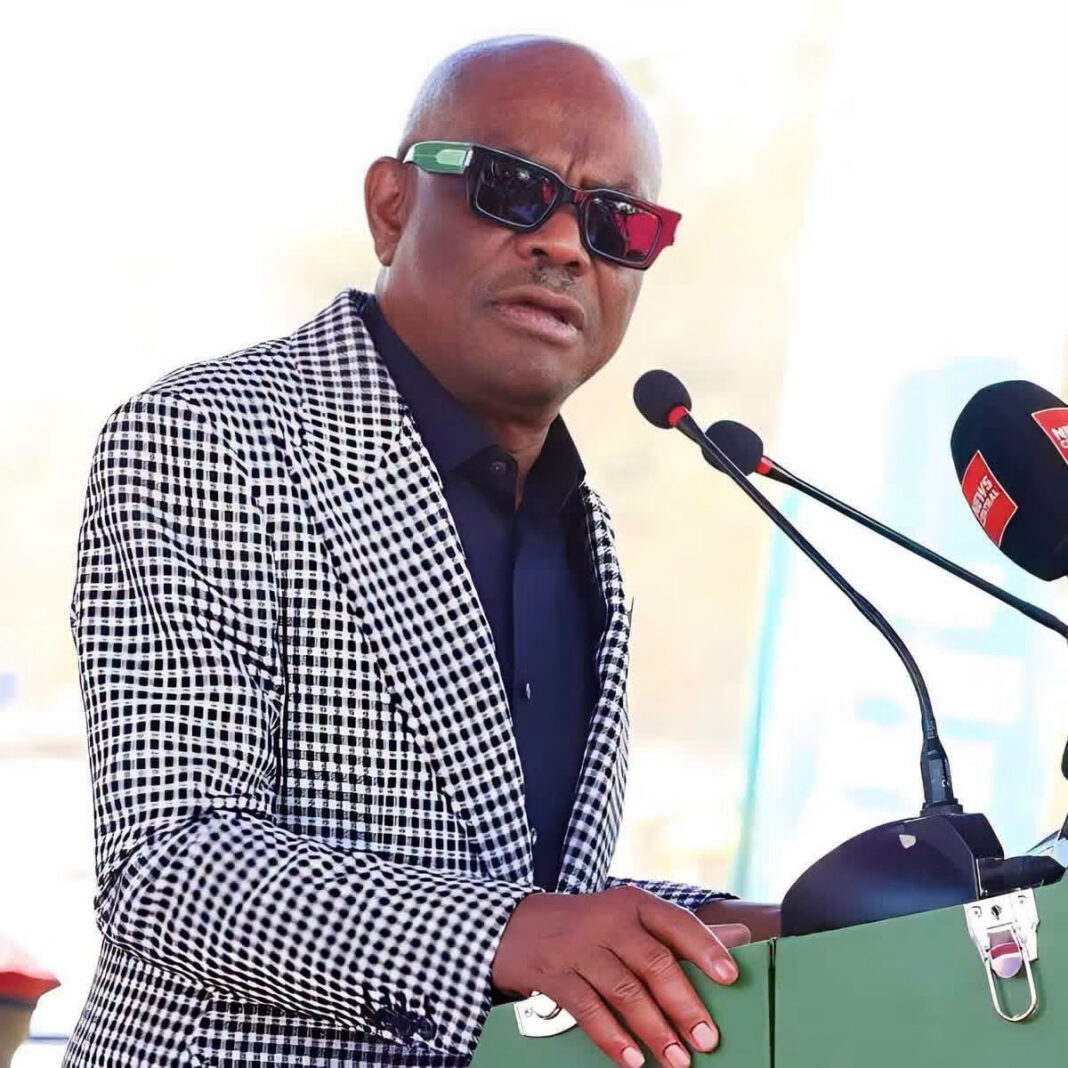

Minister of the Federal Capital Territory (FCT), Nyesom Wike, has renewed his criticism of former Vice-President Atiku Abubakar, accusing him of presiding over the sale of Nigeria’s public assets during the administration of former President Olusegun Obasanjo and warning that he would sell the country if elected president in 2027.
Wike made the remarks on Friday, November 6, 2026, while addressing political stakeholders at a Rainbow Coalition town hall meeting in Asari-Toru Local Government Area of Rivers State.
The FCT minister challenged Atiku, who is seeking the presidency under the African Democratic Congress (ADC), to account for the outcome of government-owned enterprises privatised during his eight-year tenure as vice-president between 1999 and 2007.
“Atiku Abubakar was vice president for eight years. He was in charge of privatisation. He sold assets belonging to Nigeria. Now ask him, what happened to all the government companies that he sold? Ask him,” Wike told the gathering.
He further described the former vice-president as a political gambler, questioning his consistency and arguing that Nigerians should not entrust the country’s future to someone who has repeatedly pursued the presidency.
Wike alleged that Atiku, if elected, would attempt to recover money spent on his previous presidential campaigns rather than concentrate on governing the country.
“He will sell Nigeria to recover all what he has spent since he has been contesting for President. He is not a man that you can take his word to the bank. What he says in the morning is not what he’ll say in the afternoon,” he said.
The minister also used the occasion to defend President Bola Tinubu’s economic policies, particularly the removal of petrol subsidy, arguing that the decision had increased revenue allocations to state and local governments.
Although acknowledging the economic difficulties facing Nigerians, Wike maintained that increased allocations had improved the ability of subnational governments to meet obligations such as salaries and pension payments.
He also cited the absence of prolonged nationwide strikes by the Academic Staff Union of Universities (ASUU) during the Tinubu administration as an achievement, urging Nigerians to remain patient with the government’s reforms.
However, Wike’s allegations have revived a longstanding political debate about Atiku’s role in Nigeria’s privatisation programme under the Obasanjo administration.
Atiku served as chairman of the National Council on Privatisation (NCP), the policy and supervisory body responsible for overseeing the government’s privatisation programme. The Bureau of Public Enterprises (BPE), however, is the agency mandated to implement the programme and carry out the technical and administrative processes involved in the disposal of public enterprises.
The distinction is important in assessing claims about individual responsibility for specific transactions. While Atiku chaired the council during the period, Wike’s allegation that he personally sold national assets remains a political accusation that requires evidence on individual transactions to establish responsibility.
Atiku has previously defended his role in the privatisation exercise, arguing that the process was conducted through established government institutions and legal procedures. In 2016, he also disclosed that he had advocated the privatisation of the Nigerian National Petroleum Corporation before the Obasanjo administration took office, although the proposal was opposed by the former president.
Wike’s latest comments add to the growing political exchanges surrounding the 2027 presidential contest, particularly as the FCT minister continues to mobilise support for Tinubu’s re-election bid across Rivers State.
The controversy places renewed attention on the performance of past administrations, the management of public assets and the accountability of political leaders seeking another opportunity to govern Nigeria.
IBN News — Fearless, Strong & Reliable