
The Nigeria Labour Congress (NLC) has rejected claims that it negotiated the ₦40,000 consequential salary adjustment for federal workers, insisting that the responsibility for the agreement rested with public sector unions and their negotiating structures.
The Congress described the attribution of the salary adjustment to its leadership as false and misleading, accusing unnamed individuals and groups of deliberately distorting Nigeria’s collective bargaining framework to create confusion among workers.
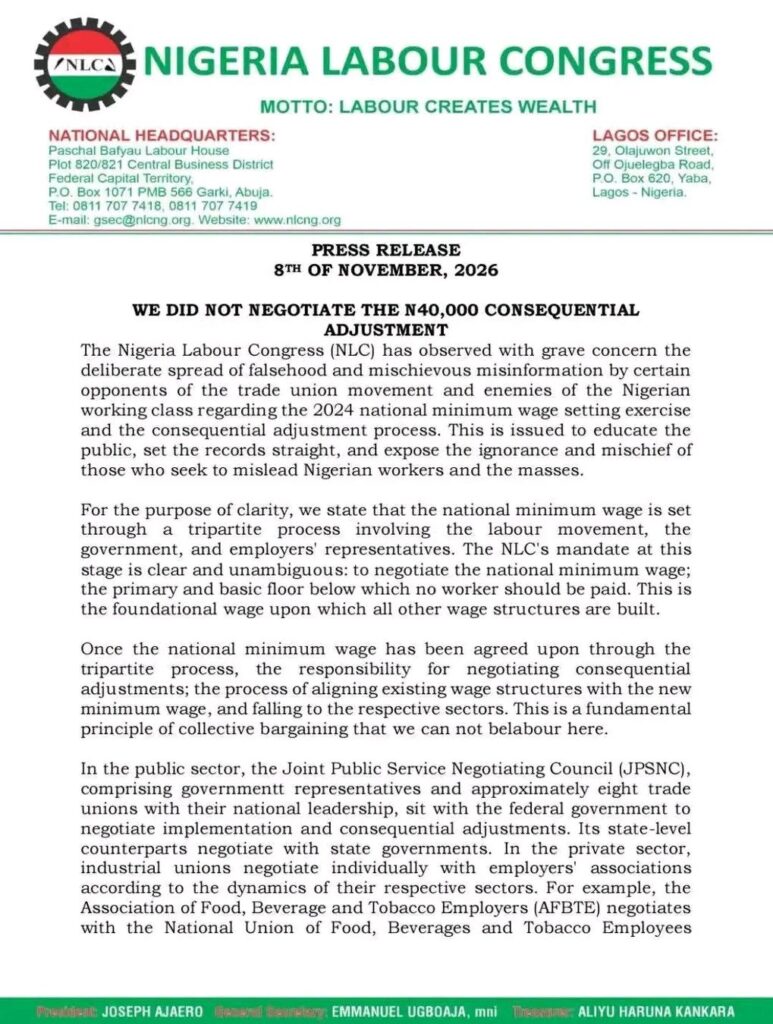
In a press statement dated November 8, 2026, the NLC said its responsibility during the 2024 national minimum wage negotiations was to negotiate the national minimum wage itself, which establishes the basic legal threshold below which no worker should be paid.
It explained that consequential adjustments are separate negotiations intended to align existing salary structures with a newly approved minimum wage. According to the Congress, those negotiations are conducted by relevant unions and employers within their respective sectors.
The NLC specifically identified the Joint Public Service Negotiating Council (JPSNC) as the platform responsible for negotiating the implementation of the minimum wage and consequential adjustments in the federal public service.
The council comprises government representatives and trade unions, whose leadership engages the Federal Government on salary structures and other conditions of service. At the state level, corresponding negotiating councils engage state governments, while industrial unions negotiate with employers’ associations in the private sector.
Citing the food and beverage industry as an example, the Congress said the Association of Food, Beverage and Tobacco Employers (AFBTE) negotiates with the National Union of Food, Beverages and Tobacco Employees (NUFBTE) on matters affecting workers in the sector.
The labour centre stressed that although it represents workers across public and private sectors, it does not directly negotiate consequential adjustments for individual sectors.
It maintained that the outcome of the ₦40,000 adjustment for federal workers was the responsibility of public sector union leaders operating through the appropriate negotiating arrangements.
The NLC stated: “The claim that the NLC was responsible for negotiating the N40,000 across-the-board addition as consequential adjustment for federal workers is not only false but is a deliberate distortion of the collective bargaining framework in Nigeria.”
It further argued that its leadership had never directly negotiated consequential adjustments with the Federal Government or private-sector employers throughout the history of national minimum wage negotiations.
The clarification comes amid renewed disagreements among organised labour leaders over the handling of workers’ remuneration and representation in negotiations with the Federal Government.
On November 2, 2026, Channels Television reported comments by Trade Union Congress (TUC) President Festus Osifo, who criticised the manner in which the consequential adjustment following the 2024 minimum wage increase was handled. Osifo alleged that a flat ₦40,000 was applied across salary levels instead of adjustments that properly reflected differences in workers’ grade levels.
The disagreement has brought renewed attention to the role of the Joint National Public Service Negotiating Council and the respective responsibilities of the NLC, TUC and affiliated unions in representing workers.
The Federal Government had increased the national minimum wage from ₦30,000 to ₦70,000 in 2024. Following the approval, government and labour representatives negotiated consequential adjustments through a committee chaired by the Head of the Civil Service of the Federation. The committee subsequently signed a memorandum of understanding on the revised salary arrangements in September 2024.
Against this background, the NLC warned that attempts to blame its leadership for the outcome of the ₦40,000 adjustment could weaken solidarity within the labour movement and undermine workers’ confidence in their representative institutions.
The Congress urged Nigerian workers to reject what it described as propaganda and misinformation, while calling for stronger cooperation between the NLC and the TUC.
It also reaffirmed its commitment to the welfare of Nigerian workers, expressing determination to ensure that the forthcoming national minimum wage negotiations produce an outcome capable of improving workers’ living conditions.
The statement was issued under the Nigeria Labour Congress’ national leadership, with the Congress insisting that accountability for consequential salary negotiations must rest with the institutions and union representatives directly involved.
IBN News — Fearless, Strong & Reliable