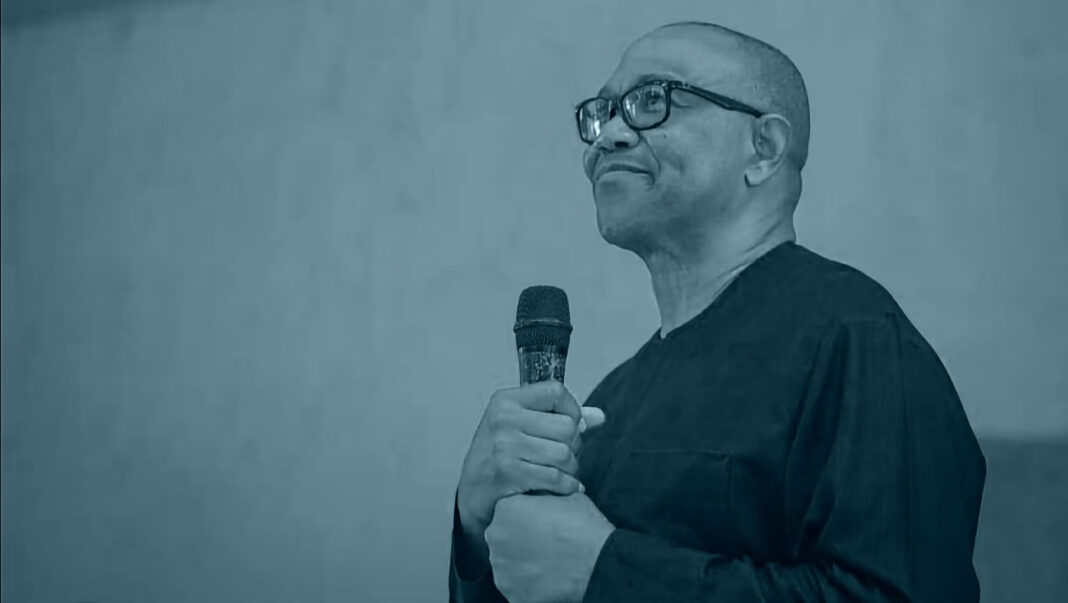

Former Anambra State Governor and Nigeria Democratic Congress (NDC) presidential candidate, Peter Obi, has challenged President Bola Tinubu to give Nigerians a detailed account of how his administration has utilised resources generated through fuel subsidy removal, foreign borrowings, taxation and increased government revenues.
Obi made the demand in an open message titled “Good Day, Mr President: Nigerians Deserve Accountability,” released on Saturday, November 7, 2026, following Tinubu’s visit to Akwa Ibom State, where the President spent a night outside Lagos and Abuja.
In the message, Obi congratulated Tinubu on the visit but urged him to extend similar engagements to the remaining 33 states of the federation, interact with ordinary Nigerians and explain what his government had achieved with the resources available to it.
He specifically demanded an account of the ₦15.8 trillion in subsidy-related savings, more than $100 billion in borrowings, increased tax revenues and additional government earnings which the administration reportedly said had surpassed its target.
The former Anambra governor said Nigerians deserved measurable evidence of how these resources had improved their lives, asking how many citizens had been lifted out of poverty, how many out-of-school children had returned to classrooms and how many functional primary healthcare centres had been built.
He also questioned the administration’s performance in the electricity sector, recalling Tinubu’s earlier promise that Nigerians should not vote for him if he failed to fix the country’s power supply.
On security, Obi called for an explanation of what the government had achieved in protecting citizens, arguing that Nigerians continued to face serious security challenges.
“Mr President, Nigerians deserve answers. They deserve to know what has been done with the resources entrusted to your government,” Obi said.
He maintained that accountability, transparency and measurable improvements in citizens’ living conditions must form the foundation of the Nigeria the country seeks to build.
The demand comes amid continuing public debate over the economic consequences of the Tinubu administration’s reforms, particularly the removal of petrol subsidy and the unification of the foreign exchange market.
However, the Federal Government has previously provided its own breakdown of the subsidy-related savings. In August 2026, Finance Minister Taiwo Oyedele said ₦15.8 trillion was mobilised for the Federation between June 2023 and December 2025. The government’s figures put the Federal Government’s share at approximately ₦5.43 trillion, while states received ₦6.52 trillion and local governments ₦3.88 trillion.
The government also reported that the Federal Government recorded ₦20.4 trillion in incremental resources during the period, comprising its share of subsidy-related savings, additional independent revenue and incremental borrowing. It said incremental expenditure stood at approximately ₦30.6 trillion.
The figures provide an official account of the resources and expenditure recorded by the government, but questions about the direct impact of the spending on poverty, education, healthcare, electricity and security remain central to the national debate.
Obi’s intervention therefore places renewed emphasis on the need for government to demonstrate not only how much money has been generated or spent, but also what Nigerians have gained from the policies and public resources entrusted to those in power.
He concluded by declaring that a new Nigeria was possible, insisting that its foundation must be built on accountability, transparency and tangible results for citizens.
IBN News — Fearless, Strong & Reliable