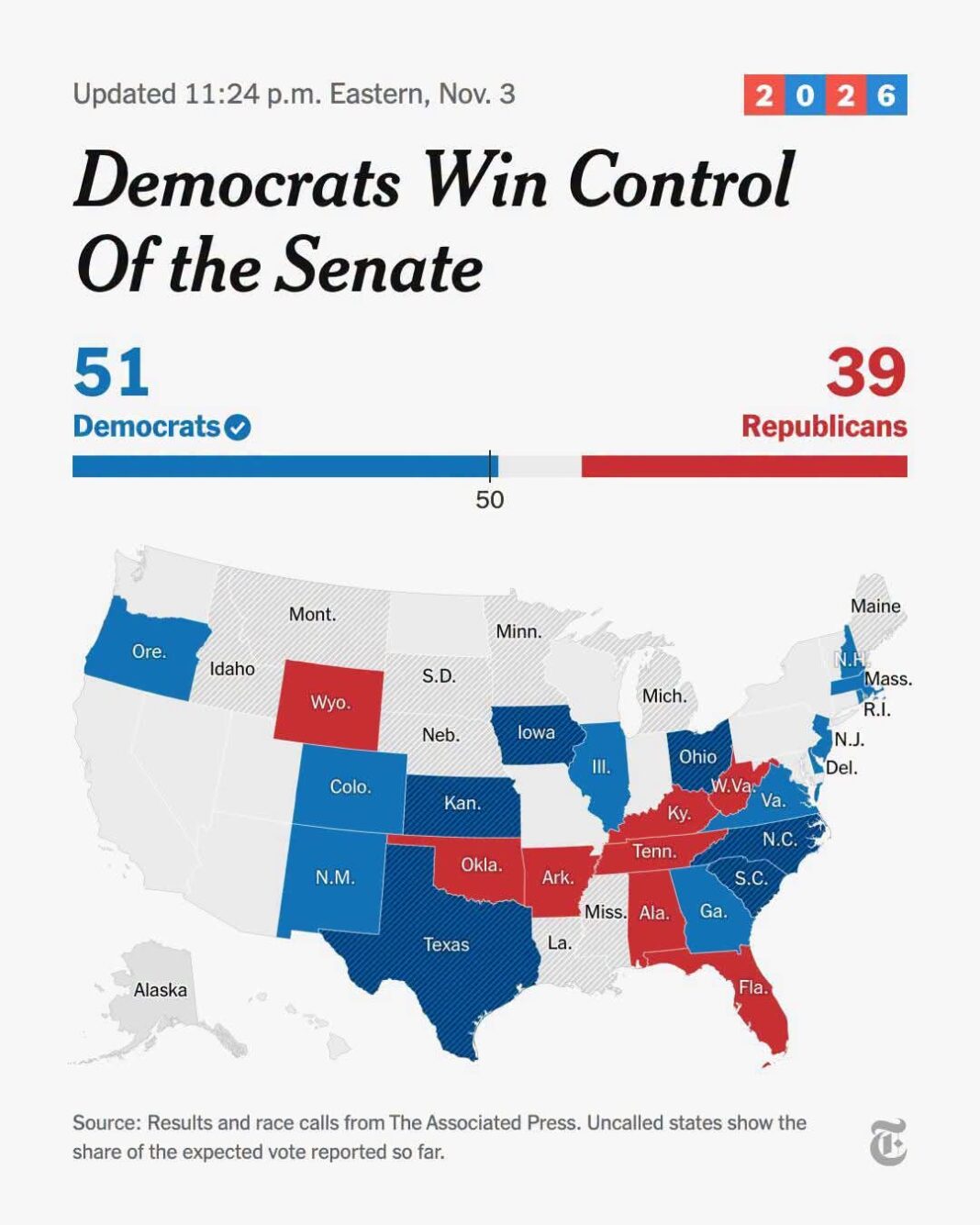

Democrats have regained control of the United States Senate following major victories in the November 3, 2026, midterm elections, delivering a significant political setback to President Donald Trump and the Republican Party.
The Democratic gains came as voters handed the party victories in several traditionally Republican states, dramatically reshaping the political balance in Washington and raising questions about the future direction of Trump’s administration.
According to reports by the Associated Press, Democrats secured Senate victories in states including Texas, Kansas, South Carolina, Iowa, Ohio and North Carolina, flipping Republican-held seats and overcoming what had initially been viewed as a challenging electoral map.
The victories in Texas, Kansas and South Carolina were particularly significant because Democrats had struggled for decades to win Senate seats in those states. The results underscored the scale of the party’s gains and the challenges facing Republicans in maintaining their congressional majority.
The election outcome represents a major blow to Trump, whose administration and political agenda were central issues during the campaign. Voters expressed concerns about rising living costs, the economy, the war in Iran and allegations of government corruption, according to election coverage.
With control of the Senate, Democrats will have greater power to scrutinise the administration, conduct congressional investigations and influence the consideration of presidential nominees, including appointments to federal positions and the judiciary.
Trump responded to the Republican losses by seeking to distance himself from the results, arguing that he had not personally been on the ballot. He also signalled his intention to use presidential veto powers to oppose legislation advanced by a Democratic-controlled Congress.
The battle for control of the House of Representatives was also a major focus of the election. Initial Associated Press reporting indicated that Democrats were making substantial gains and moving closer to securing a majority, potentially giving the party control of both chambers of Congress.
A Democratic majority in the House alongside its Senate victory would significantly alter the political landscape during the final two years of Trump’s presidency, providing the opposition party with greater oversight powers and the ability to obstruct parts of his legislative programme.
The results are also expected to influence the future strategies of both parties as they assess voter dissatisfaction, campaign priorities and their prospects in subsequent national elections.
For Republicans, the losses expose the difficulties of defending congressional seats during a midterm election marked by concerns about the administration’s performance. For Democrats, the victories provide a renewed opportunity to challenge the president’s policies and establish themselves as a stronger counterweight to the White House.
As outstanding races are resolved and results are finalised, the immediate consequence is clear: Democratic control of the Senate marks a major shift in Washington’s political balance and creates a more difficult legislative environment for Trump.