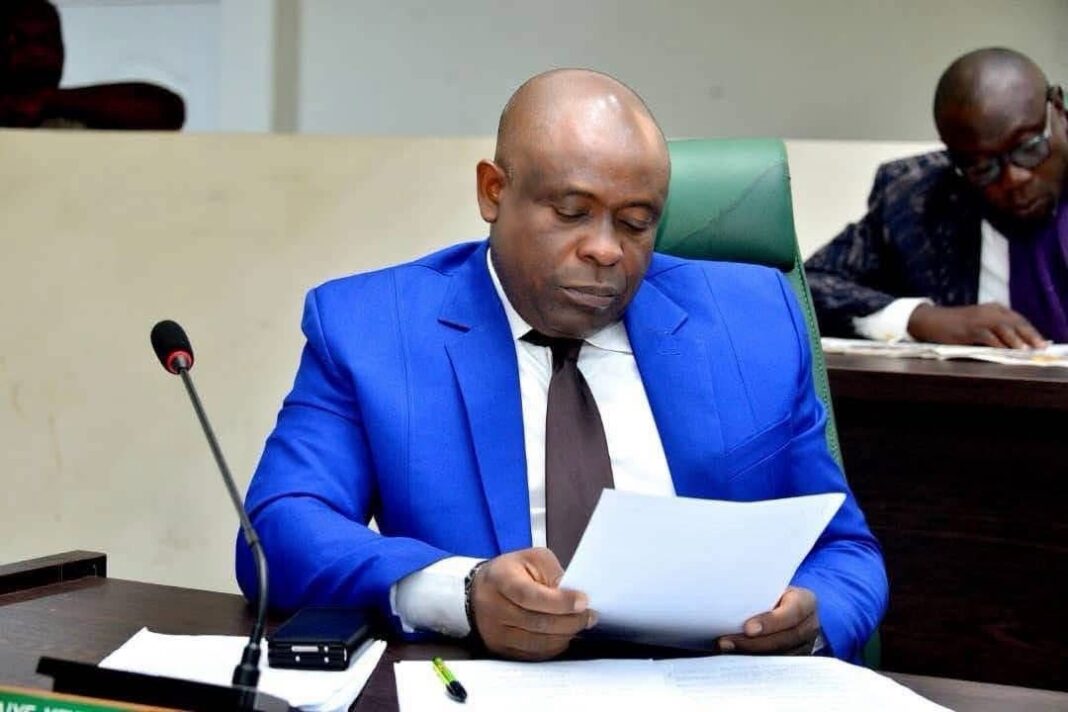

The Speaker of the Edo State House of Assembly, Hon. Yekini Idiaye, has rejected concerns that the recent amendment to the state’s financial autonomy laws has stripped the legislature and judiciary of their financial independence.
The Speaker spoke after Governor Monday Okpebholo assented to the Edo House of Assembly Funds Management Bill 2023 and the State Judiciary Financial Autonomy 2023 Amendment Bill, bringing the amended laws into effect.
Idiaye insisted that the amendments do not abolish the financial autonomy of the Edo State House of Assembly or the judiciary.
According to him, the major change introduced by the new legislation concerns the management and implementation of capital expenditure, while recurrent expenditure, including salaries and other routine obligations, will continue to be handled directly by the respective institutions.
The Speaker explained that the amendment was prompted by concerns over the management of capital funds under the previous arrangement.
“It is the capital part of the funds that has issues. It was badly abused,” Idiaye said.
Under the amended framework, the Assembly and judiciary are expected to submit proposals for capital projects, which will then be considered and approved through the state’s appropriation process.
Idiaye maintained that this arrangement should not be interpreted as the removal of financial autonomy.
“The autonomy is still in place; there is no fear on any side, and the unions should not have any fear,” he said.
He further stressed that the salaries and recurrent expenditure of workers within the Assembly and judiciary would not be affected by the new arrangement.
The clarification comes amid controversy that followed the introduction of the bills at the Edo State House of Assembly.
Initial concerns surrounding the legislation centred on fears that the proposed amendments could weaken the financial independence of the legislature and judiciary, two institutions constitutionally recognised as separate arms of government.
The development also attracted the attention of workers and organised labour, including members of the Judicial Staff Union of Nigeria, JUSUN, who raised concerns over the possible implications of the proposed changes.
JUSUN and some legal practitioners had argued that genuine financial independence was essential to the effective functioning of the judiciary and the legislature, particularly in ensuring that the two arms of government can perform their constitutional responsibilities without undue interference.
Governor Monday Okpebholo, however, defended the amendments, arguing that the objective was not to undermine institutional independence but to ensure greater accountability in the utilisation of capital funds.
The governor’s position is that public funds allocated for capital projects must translate into visible and measurable development for the people of Edo State.
The new legislation therefore introduces a different approach to the handling of capital expenditure by the Assembly and judiciary, while the Speaker insists that their operational and recurrent financial autonomy remains intact.
The controversy has consequently shifted from whether autonomy has been completely removed to the broader question of how financial autonomy should be balanced with accountability and oversight in the management of public funds.
For the judiciary and legislature, the issue remains significant because financial independence is widely regarded as an important element of institutional independence.
For the state government, however, ensuring that capital allocations are properly planned, approved and utilised remains a central part of public financial management.
With Governor Okpebholo’s assent, the amended laws have now taken effect, setting the stage for further discussions among lawmakers, judicial workers, labour unions, legal practitioners and other stakeholders across Edo State.
The Edo State House of Assembly leadership is expected to continue defending the new framework and explaining its implications to workers and the wider public.
Meanwhile, stakeholders who remain opposed to the amendments may seek further clarification or pursue available constitutional and legal avenues to challenge provisions they believe could undermine the independence of either institution.
The debate over the legislation is therefore unlikely to end with the governor’s assent, as questions surrounding financial autonomy, legislative independence, judicial independence, accountability and executive oversight remain central to the ongoing discussion.
For now, the Edo Assembly leadership maintains its position that financial autonomy has not been removed, and that the amendment is primarily aimed at tightening the management of capital funds.
IBN NEWS will continue to monitor the controversy and bring you developments from the Edo State House of Assembly, the judiciary, JUSUN and other stakeholders.
IBN NEWS — FEARLESS, STRONG & RELIABLE.