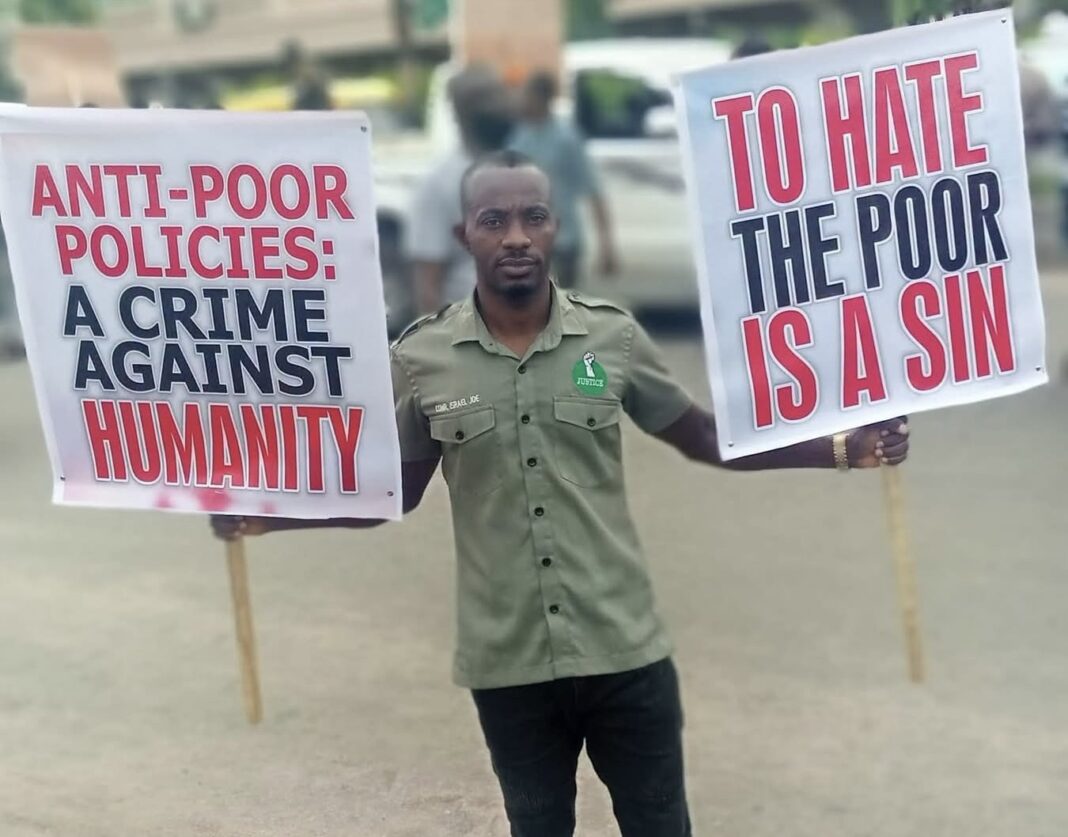


LAGOS, Nigeria — Comr. Israel Joe, popularly known as Table Breaker, has launched a scathing criticism of Nigeria’s telecommunications industry and political establishment over the cost of airtime and data, alleging that ordinary Nigerians are being left to bear the burden of rising communication expenses.
In a strongly worded statement, the activist called out major mobile network operators, including MTN Nigeria, Globacom and Airtel, claiming that decisions affecting subscribers were reached through discussions involving selected stakeholders and politicians without adequate consideration of the people who ultimately pay for the services.
Joe further alleged that government officials were aware of the arrangements surrounding telecommunications pricing and suggested that political interests had been accommodated. However, he did not provide documentary evidence to substantiate claims of secret negotiations or agreements involving politicians and network operators.
The activist challenged Nigerians to assess the value they receive when purchasing airtime, urging subscribers to recharge their phones with ₦5,000 and examine how quickly their balances are depleted. He argued that the rising cost of staying connected has placed additional pressure on citizens who depend on mobile services for business, education, employment and everyday communication.
Joe also accused politicians of being disconnected from the financial realities facing ordinary Nigerians, alleging that some benefit from airtime allocations provided by telecommunications companies instead of purchasing recharge cards with their personal funds.
He argued that such arrangements, where they exist, could insulate public officials from the effects of rising communication costs while millions of citizens struggle to afford calls and internet access.
The activist also criticised what he described as a system in which young Nigerians receive inadequate financial rewards while being expected to defend political interests despite the economic hardship confronting them.
His comments have brought renewed attention to the affordability of telecommunications services in Nigeria, where mobile connectivity has become essential for financial transactions, digital businesses, education, news consumption and access to government services.
The controversy surrounding telecom pricing dates back to January 2025, when the Nigerian Communications Commission (NCC) approved tariff adjustments of up to 50 per cent following requests from operators facing rising operating costs. The operators had reportedly sought increases exceeding 100 per cent, but the regulator capped the approved adjustment at 50 per cent. The NCC said the decision was intended to address the gap between operating costs and revenue while supporting the sustainability of telecommunications services.
The approval marked the first major industry-wide tariff adjustment in more than a decade, with operators subsequently revising prices for some voice and data packages. The development triggered widespread public criticism, with the Nigeria Labour Congress rejecting the increase and announcing plans for nationwide protests in February 2025 over its impact on workers and other consumers.

In June 2026, the Association of Licensed Telecom Operators of Nigeria said there was no immediate plan for another consumer tariff increase amid an ongoing regulatory review. Its chairman, Gbenga Adebayo, explained that discussions with the NCC concerned industry pricing arrangements for calls carried and terminated across different networks, rather than an imminent increase in consumer tariffs.
Nevertheless, complaints over service quality, billing and data depletion have remained a major source of consumer frustration. Figures reported in September 2026 showed that Nigerian mobile network operators received 413,587 complaints from subscribers during the first half of the year.
Airtel accounted for 228,992 complaints, followed by MTN with 124,405, Globacom with 56,810 and T2mobile, formerly 9mobile, with 3,885. The complaints covered several issues, including network quality, disputed charges, unsuccessful transactions and disappearing data. The figures demonstrate the scale of consumer dissatisfaction but do not, by themselves, establish that tariff increases or deliberate misconduct caused every complaint.
The NCC’s consumer protection guidelines require operators to present tariff information clearly, including prices, data allowances, validity periods, out-of-bundle charges and renewal conditions. The commission also provides channels through which subscribers can escalate unresolved complaints.
Joe maintained that he would continue speaking out on issues affecting Nigerians, insisting that citizens must decide how to respond to the information he shares.
His allegations concerning secret agreements, government involvement and preferential airtime allocations remain unverified. No evidence reviewed for this report independently establishes that politicians negotiated the tariff adjustments in exchange for benefits from telecommunications operators.
The central issue remains the burden of communication costs on ordinary Nigerians and the demand for transparent pricing, reliable network services and stronger consumer protection.
For millions of subscribers, the expectation is straightforward: every naira spent on airtime and data should deliver clear value, while regulators and network operators must be accountable for the prices charged and the quality of service provided.