
ABUJA, NIGERIA — Nigeria is expanding its natural gas infrastructure through a network of pipelines designed to connect gas-producing areas with power plants, industrial clusters and major demand centres across the country, with Imo State emerging as an important part of the eastern-to-national gas supply system.
The development comes alongside major infrastructure initiatives including the advancement of the Gateway Deep Seaport in Ogun State and the opening of a new Economic and Financial Crimes Commission (EFCC) zonal directorate in Awka, Anambra State.
In Imo State, the Assa North-Ohaji gas development has become an important component of the country’s domestic gas strategy.
The Nigerian National Petroleum Corporation Limited’s 2026 Gas Master Plan identifies Assa North in Ohaji/Egbema and Izombe in Oguta, Imo State, as strategic gas hubs. The plan includes infrastructure intended to move gas from producing areas towards major demand centres.
A key part of this network is the Obiafu-Obrikom-Oben (OB3) Gas Pipeline, which is designed to connect the eastern gas network with the western and northern gas corridors.
The 130-kilometre OB3 pipeline recently reached a major milestone with the completion of its technically challenging River Niger crossing. The project is expected to strengthen Nigeria’s national gas transmission network and facilitate the movement of large volumes of gas towards demand centres.
The network also connects with the Ajaokuta-Kaduna-Kano (AKK) Gas Pipeline, a 623-kilometre pipeline designed to transport gas from Ajaokuta towards Kaduna and Kano.
According to the 2026 NNPC Gas Master Plan, the AKK has a planned capacity of about 2.2 billion cubic feet of gas per day and is intended to serve northern demand, including power generation and industrial activities.
The wider system also includes the proposed ELPS-Ibadan-Ilorin-Jebba pipeline, which is intended to supply gas to power-intensive industries and power plants along the corridor. The NNPC plan lists the project as a proposed 484-kilometre pipeline beginning from the Escravos-Lagos Pipeline System in Ogun State.
The developments are part of the Federal Government’s broader effort to increase domestic gas utilisation, support electricity generation and provide gas feedstock for industries.
In Imo State, the Assa North-Ohaji South gas project has already begun supplying gas to industrial customers. The facility was designed to process approximately 300 million standard cubic feet of gas per day, with production being ramped up as commissioning progresses.
The federal government has previously described the ANOH and associated pipeline infrastructure as projects capable of increasing domestic gas availability for the power sector and gas-based industries.
Ogun advances deep-seaport project
While gas infrastructure is being expanded, Ogun State is also moving forward with plans for a major maritime development.
In September, the Ogun State Government and global port operator DP World signed Memoranda of Understanding for the development of the Gateway Deep Seaport and the Ogun State Blue Marine Special Economic Zone.
President Bola Ahmed Tinubu witnessed the signing ceremony in Paris on September 24, 2026.
The proposed deep-sea port at Ogun Waterside is planned with a four-kilometre berth and an 18-metre draft. The Federal Government said the project is expected to help decongest the Lagos port corridor and reduce logistics bottlenecks affecting importers, exporters and businesses.
The Federal Ministry of Information reported that the wider development framework could attract more than $7 billion in initial investment and create more than 50,000 direct jobs at full development.
The Ogun project is also being positioned alongside other infrastructure, including the Gateway International Airport, dry-port facilities and the Lagos-Calabar Coastal Highway.
The Federal Government had earlier received 130 hectares of land from Ogun State for the development of the Ijebu-Ode Inland Dry Port, another component of the state’s emerging logistics infrastructure.
EFCC opens Awka zonal directorate
In Anambra State, the Economic and Financial Crimes Commission has also expanded its operational presence with the opening of a new zonal directorate in Awka.
The facility, officially commissioned on Friday, October 2, 2026, will serve Anambra and Imo states.
EFCC Chairman Ola Olukoyede said the new office was intended to strengthen the commission’s ability to investigate and prosecute economic and financial crimes while improving access to the agency’s services in both states.
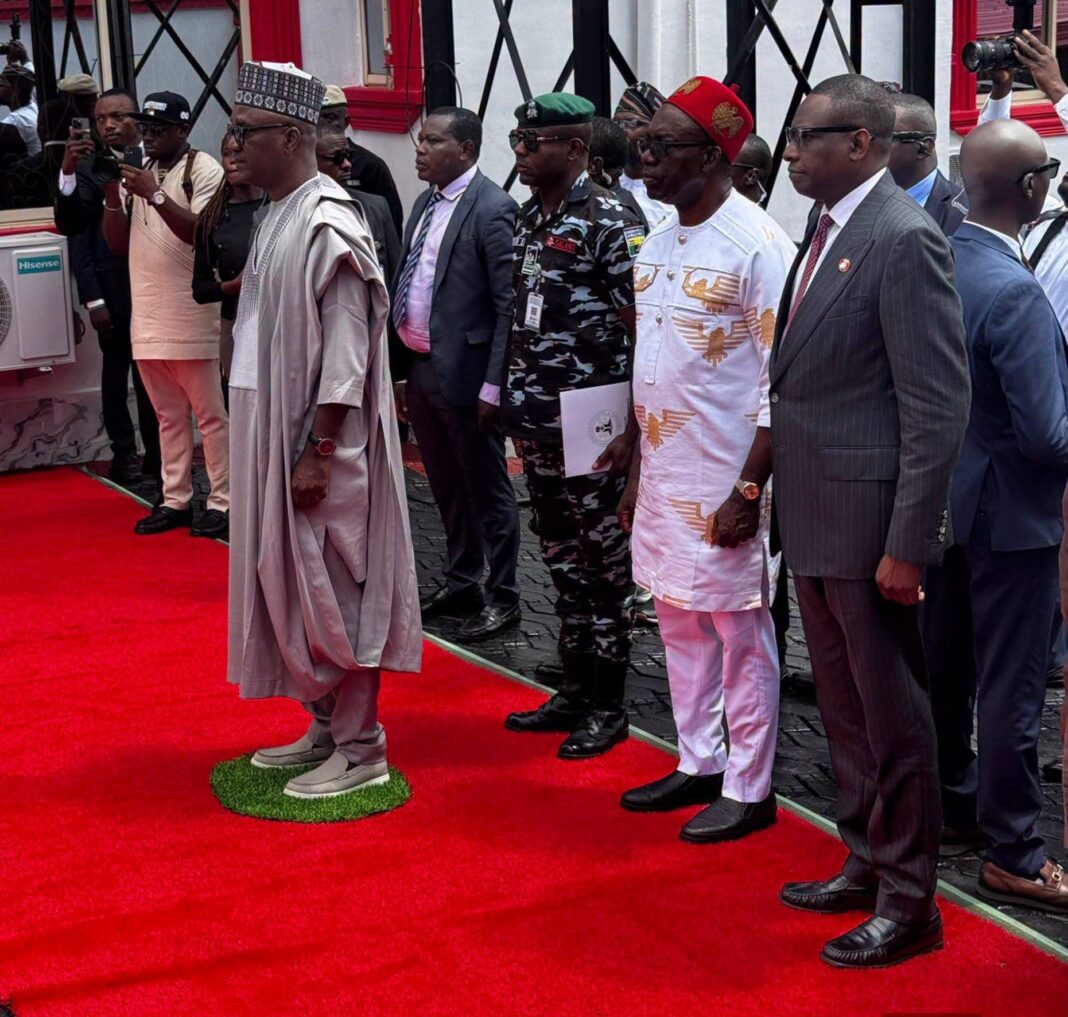
The opening was attended by prominent figures including Anambra State Governor Chukwuma Soludo, Imo State Governor Hope Uzodimma, House of Representatives Speaker Tajudeen Abbas and other government officials. President Tinubu was represented at the ceremony by Abbas.
The EFCC said the Awka directorate forms part of a wider expansion of its operational presence across Nigeria.
The commission had earlier disclosed that the Awka office would serve both Anambra and Imo, with the aim of improving operational efficiency and bringing enforcement activities closer to residents and businesses.
Olukoyede also disclosed that the commission is increasingly focusing on preventing the diversion of public funds rather than relying solely on recovering money after it has been stolen.
Taken together, the developments in gas infrastructure, maritime transport and financial-crime enforcement point to a broader expansion of federal and state infrastructure across different regions of Nigeria.
For the gas sector, the key challenge remains not simply laying pipelines but ensuring that gas reaches power plants and industrial consumers reliably and at commercially sustainable prices.
IBN News will continue to track the progress of these projects, including the OB3 and AKK gas corridors, the Gateway Deep Seaport and the new EFCC Awka directorate.