
LAGOS GOVERNOR USES INTERNATIONAL AWARD TO SELL STATE AS AFRICA’S INVESTMENT DESTINATION
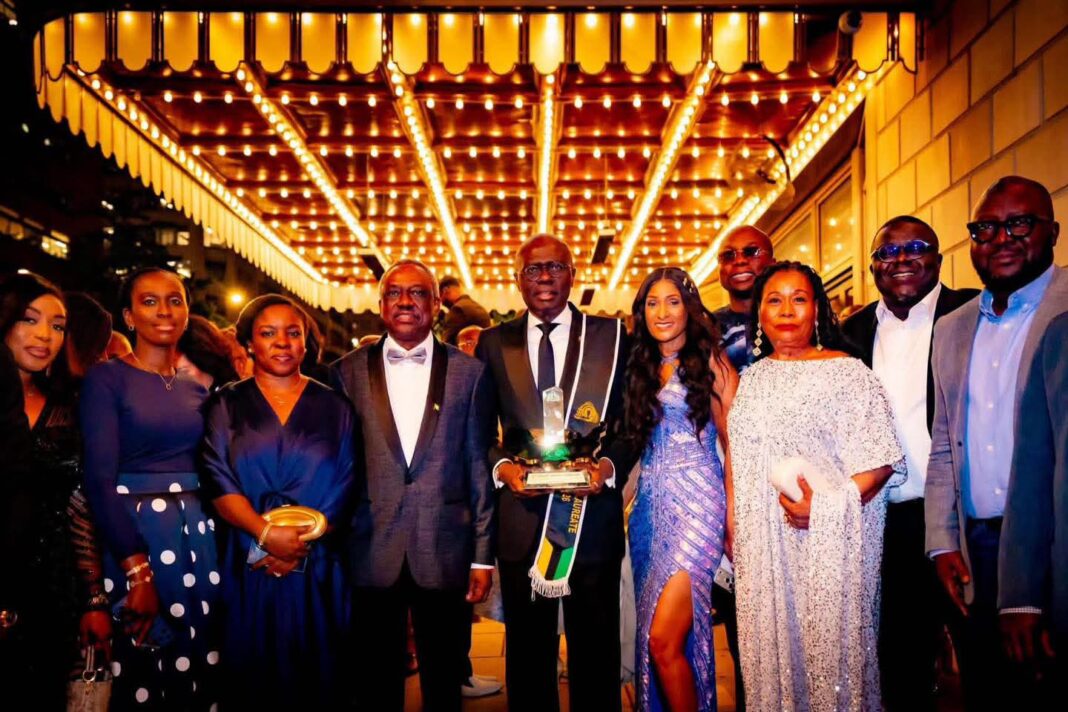
Lagos State Governor Babajide Sanwo-Olu has received the 2026 Global Transformation and Good Governance Prize at the Warner Theatre in Washington, D.C., with the governor using the international recognition to highlight Lagos State’s economic growth, infrastructure development and investment opportunities.
Sanwo-Olu, who accepted the award on behalf of more than 25 million residents of Lagos, said the recognition belonged not only to his administration but to the people of the state who continue to contribute to the growth and development of Lagos.
The governor used the occasion to present Lagos as one of Africa’s leading economic centres and urged international investors to look towards the state for opportunities in infrastructure, transportation, manufacturing, technology and other sectors.
According to Sanwo-Olu, Lagos has continued to strengthen its economy despite the challenges facing Nigeria and has taken steps to reduce its dependence on crude oil revenue.
He said Lagos generates more than a quarter of Nigeria’s economic output, with the state’s economy estimated at about $259 billion.
The governor also pointed to several major infrastructure projects as evidence of what he described as the transformation taking place across Lagos.
Among the projects highlighted were the Lekki Deep Sea Port, Lekki Refinery, Lagos Blue Line and Red Line rail systems and the Omi Eko electric ferry project.
Sanwo-Olu said the projects were designed not only to improve transportation and connectivity but also to create an environment capable of attracting more investment and supporting economic activities.
The governor’s appearance in Washington comes at a time when Nigerian states are under increasing pressure to demonstrate what they are doing with public resources and how their policies are translating into economic opportunities for citizens.
For Lagos, the administration has consistently presented infrastructure development as a major part of its strategy to position the state as a globally competitive city.
The Lekki corridor, in particular, has become one of the most important economic zones in the state, with major investments in port infrastructure, industrial activities, logistics and manufacturing.
The Lekki Deep Sea Port has been presented as a major gateway for international trade, while the Lekki Refinery is expected to strengthen Nigeria’s domestic refining capacity and reduce dependence on imported petroleum products.
The development of the Blue and Red rail lines has also been described as part of the state’s response to one of Lagos’ biggest challenges — transportation.
With millions of people moving across Lagos every day, traffic congestion has remained a major concern for residents, businesses and visitors.
The expansion of rail and water transportation is therefore seen as an attempt to provide alternatives to road transportation and reduce pressure on the state’s roads.
Sanwo-Olu also highlighted the Omi Eko electric ferry project as part of the state’s effort to expand water transportation and introduce cleaner transportation options.
The governor said these investments demonstrate the importance of combining infrastructure with good governance and effective execution.
He thanked the Asante Crown and the Millennium Excellence Foundation for the award, describing the recognition as an encouragement to continue working towards the development of Lagos.
The award also provides another international platform for the Lagos State Government to promote its investment story.
Sanwo-Olu told potential investors that Africa’s opportunities should not be viewed only from the perspective of challenges but also through the opportunities being created by cities implementing large-scale infrastructure and economic reforms.
He urged investors looking for opportunities in Africa to consider cities where governance, infrastructure and execution are creating an environment for businesses to grow.
The governor’s message was clear: Lagos wants to be seen not simply as Nigeria’s commercial capital, but as a major investment destination capable of competing with other leading cities around the world.
The claim is significant because Lagos remains Nigeria’s largest commercial hub and one of the most economically active urban centres on the continent.
However, the state’s development story also comes with major challenges.
Lagos continues to face serious pressure from rapid population growth, traffic congestion, flooding, housing shortages, environmental challenges and the high cost of living.
For ordinary Lagos residents, the real test of government performance is therefore not only the number of major projects completed but how those projects affect daily life.
A new rail line is important, but residents want affordable and reliable transportation.
A major port is important, but businesses want efficient logistics and lower costs.
Investment announcements are important, but young people want jobs.
Economic growth figures are important, but families want lower living costs and better access to essential services.
This is why the sustainability of Lagos’ development model will remain a major issue as the state continues to expand.
Sanwo-Olu’s administration has placed significant emphasis on infrastructure, technology, transportation, healthcare and economic development.
The international award now gives the administration another opportunity to present those efforts to a global audience.
The governor’s decision to dedicate the award to Lagos residents also places the focus on the people who ultimately experience the successes and failures of government policies.
For investors, Lagos remains attractive because of its large population, strategic location, established business community, access to international trade routes and concentration of financial institutions.
The state also has one of Nigeria’s strongest concentrations of private-sector businesses and entrepreneurs.
But attracting investment requires more than economic size.
Investors require reliable infrastructure, predictable regulations, security, efficient transportation, access to power, skilled workers and confidence that government policies will remain stable.
This is where the Lagos Government wants its infrastructure projects to make a difference.
The Blue and Red rail lines, for example, are intended to improve movement within the metropolis, while the Lekki Deep Sea Port is expected to strengthen the state’s position as a major logistics and maritime centre.
The Lekki Refinery and surrounding industrial development have also increased attention on the Lekki-Epe corridor as a major economic zone.
Meanwhile, the development of water transportation through projects such as Omi Eko is part of the government’s wider plan to diversify transportation options.
Sanwo-Olu’s message in Washington was therefore not simply about receiving an award.
It was also an investment pitch.
The governor used the international platform to tell potential investors that Lagos is building infrastructure and creating economic opportunities that can support long-term investment.
The challenge now is for the state to ensure that the benefits of those investments reach ordinary residents.
Lagos is a state of enormous economic potential, but its success cannot be measured only by the size of its economy.
The real measure will be whether economic growth creates better jobs, improves living standards, reduces transportation difficulties, expands access to healthcare and education and makes life more affordable for residents.
The governor’s international recognition will likely strengthen the administration’s argument that Lagos is making progress in infrastructure and governance.
But awards, like government projects, will ultimately be judged by their impact.
For Lagos residents, the question will remain whether the transformation being presented internationally is also being experienced at street level.
For investors, the question will be whether the infrastructure and governance reforms highlighted by the governor translate into a stable and profitable business environment.
And for the Lagos State Government, the challenge is to maintain the momentum while ensuring that rapid economic growth does not leave large sections of the population behind.
Sanwo-Olu’s Washington appearance has nevertheless placed Lagos once again in the international spotlight.
By highlighting the state’s economic strength, infrastructure projects and investment opportunities, the governor is positioning Lagos as a city determined to compete for global capital and influence.
The message from Washington is straightforward: Lagos wants the world to see the state not only as Nigeria’s biggest commercial centre, but as one of Africa’s leading economic destinations.
The bigger question now is whether Lagos can continue to turn its massive economic potential, infrastructure investments and international recognition into improved living standards for the millions of people who call the state home.