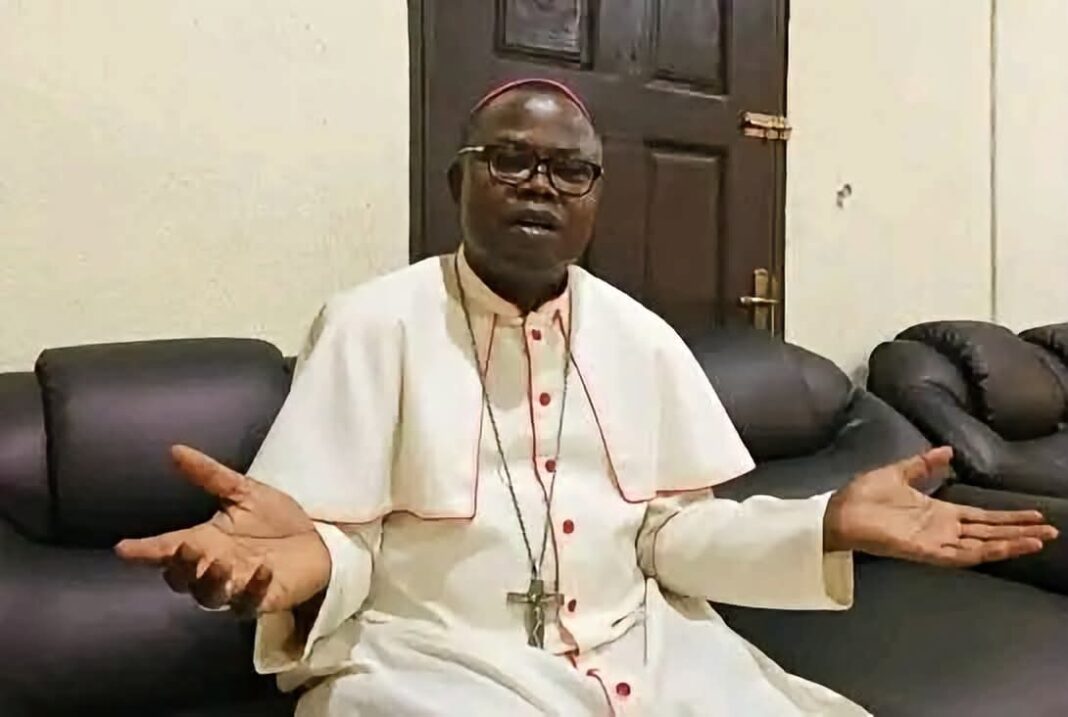

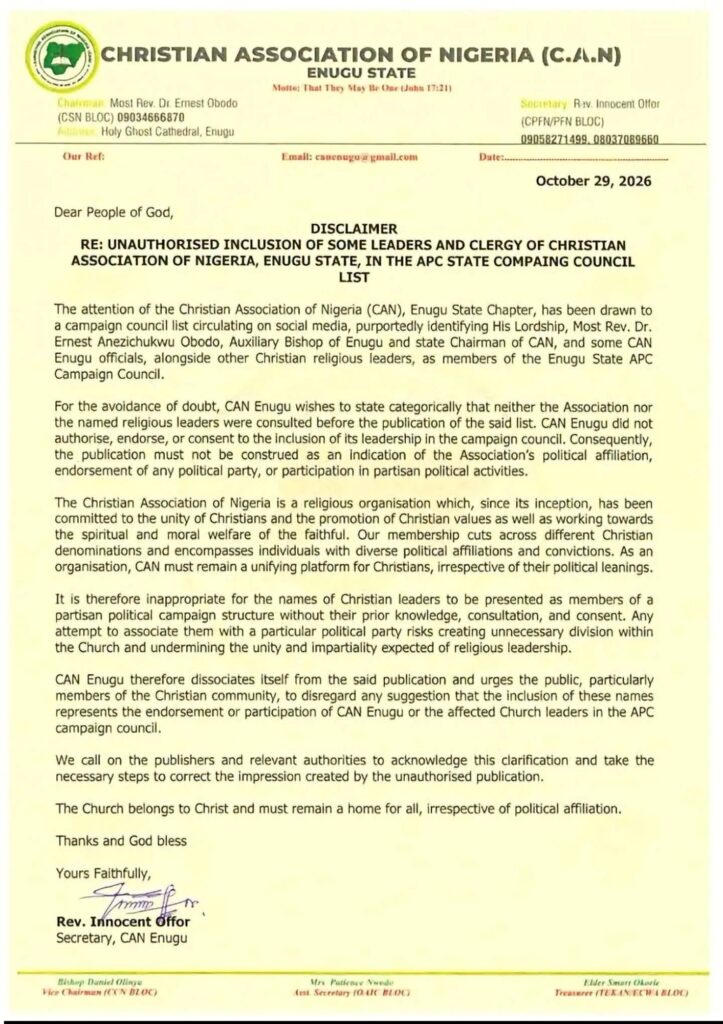
The Christian Association of Nigeria (CAN), Enugu State Chapter, has disowned a list circulating on social media that allegedly includes its state chairman, Most Rev. Dr. Ernest Ane zichukwu Obodo, and other Christian leaders as members of the All Progressives Congress (APC) State Campaign Council, declaring that neither the association nor the affected religious leaders authorised their inclusion.
In a disclaimer dated October 29, 2026, and signed by its state secretary, Rev. Innocent Offor, CAN Enugu said it was compelled to issue the clarification after its leadership was alerted to the publication, which purportedly presented senior Christian figures as members of the APC campaign structure.
The association categorically stated that it was neither consulted nor asked to approve the inclusion of its leadership in the campaign council. It stressed that it did not authorise, endorse or consent to the publication and warned against interpreting the list as evidence of CAN’s political affiliation or support for the APC.
The disclaimer specifically identified Most Rev. Dr. Ernest Anezichukwu Obodo, Auxiliary Bishop of Enugu and state chairman of CAN, alongside other association officials and Christian religious leaders, as individuals whose names were reportedly included without the necessary consultation and consent.
CAN’s position raises serious questions about the use of religious leaders’ names in partisan political structures without their authorisation. In a country where faith institutions command significant public trust and influence, the unauthorised association of religious leaders with a political party risks misleading the public and creating avoidable tension within religious communities.
The Enugu chapter emphasised that CAN is a religious organisation committed to Christian unity, the promotion of Christian values and the spiritual and moral welfare of the faithful. With members drawn from different denominations and political persuasions, it said the association must remain a unifying platform for Christians regardless of their political affiliations.
According to the statement, presenting Christian leaders as members of a partisan campaign council without their prior knowledge, consultation and consent is inappropriate and could undermine the unity and impartiality expected of religious leadership.
CAN Enugu therefore formally dissociated itself from the circulating list and urged members of the public, particularly Christians, not to interpret the inclusion of the names as an endorsement of the APC or evidence that the affected church leaders had agreed to participate in the party’s campaign activities.
The association also called on those responsible for publishing and circulating the list, as well as relevant authorities, to acknowledge its clarification and take steps to correct the impression created by the publication.
The controversy comes amid the increasingly prominent role of religious identity and influential faith leaders in Nigeria’s political environment. CAN’s disclaimer underscores the importance of obtaining explicit consent before associating individuals or institutions with political campaigns.
While political parties are free to seek support from religious leaders who voluntarily choose to participate in partisan activities, the association’s statement makes clear that such participation cannot legitimately be inferred from a name appearing on a campaign council list.
For the APC in Enugu State, the disclaimer presents a reputational challenge that calls for a clear response and clarification of how the names came to appear on the list. However, the circumstances surrounding the compilation and circulation of the disputed document, including who authorised it, remain to be independently established.
The message from CAN Enugu is unequivocal: the church must not be presented as endorsing a political party without its consent. As political activities gather momentum, the incident serves as a reminder that religious institutions and their leaders retain the right to determine whether, and in what capacity, they engage with partisan politics.