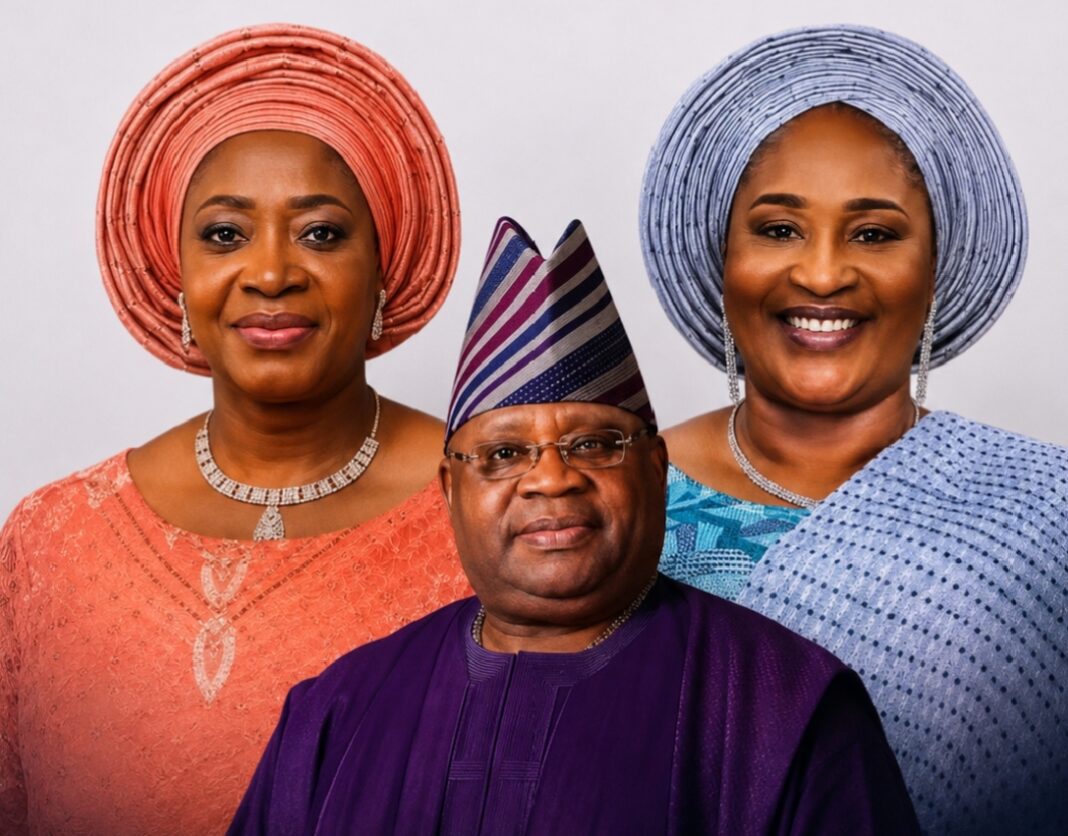

Governor Ademola Adeleke’s family life has once again opened a sensitive political conversation in Osun State, but this time, Nigerians are looking beyond the governor’s two marriages and asking a bigger question: Can one state have two First Ladies?
The controversy is not new.
Governor Adeleke is married to Titilola Adeleke and Ngozi Adeleke, and both women have appeared publicly with him. Adeleke himself referred to both women as his wives in his 2022 inaugural speech.
But the title of “First Lady” has become the real issue.
In April 2024, the matter exploded publicly when separate posters bearing the photographs of Titilola and Ngozi circulated ahead of the visit of Nigeria’s First Lady, Senator Oluremi Tinubu, to Osun State.
Both women were presented on separate publicity materials as First Lady of Osun State.
That was enough to trigger questions across social media and in the Nigerian media: Was Osun State operating with two First Ladies?
The Osun State Government quickly stepped in.
In an official statement issued on April 22, 2024, the government said there was “no confusion” over the matter and identified Chief Mrs Titilola Adeleke as the First Lady of Osun State.
The government stated that Titilola Adeleke had been directed by Governor Adeleke to officially host Senator Oluremi Tinubu during the visit.
It also dismissed a flyer attributed to Ngozi Adeleke as fake and said the material had not been authorised by her.
That statement should not be ignored.
It means that, at least according to the official position publicly issued by the Osun State Government, Titilola Adeleke was the officially recognised First Lady for that state function.
But the controversy did not simply disappear.
Reports at the time showed that both women had been associated with the First Lady title in public materials and social media profiles, creating a situation that was unusual even by Nigeria’s political standards.
And that is why the Adeleke situation remains important.
This is not simply about who sits beside the Governor at a state function.
It raises questions about political protocol, public perception, government communication and the growing influence of the families of elected politicians.
The first fact Nigerians must understand is simple: the Nigerian Constitution does not create an office called “First Lady.”
The Constitution creates the office of Governor.
Section 176 of the 1999 Constitution provides for a Governor for every state and identifies the Governor as the Chief Executive of the state.
The Constitution also creates the office of Deputy Governor and provides for the various institutions and offices through which the government of a state operates.
But there is no constitutional provision establishing an Office of the First Lady.
There is therefore no constitutional provision saying a state must have one First Lady, two First Ladies or no First Lady.
The title developed through political practice, tradition and official protocol.
That distinction matters.
A First Lady is not elected by the people.
She does not receive votes.
She does not take an oath of office as Governor.
She does not become the Chief Executive of the state because she is married to the Governor.
And she cannot exercise the constitutional powers of the Governor simply because she is called First Lady.
So, technically, the question is not whether the Constitution permits “two First Ladies.”
The Constitution does not even establish the office in the first place.
The real question is whether a state government should officially use the title for more than one woman and, more importantly, whether any public authority, privilege, appointment, funding or government machinery is attached to that title.
That is where the matter becomes serious.
If the title is simply ceremonial, Nigerians may argue about tradition, culture, marriage and personal choice.
But if an “Office of the First Lady” is operating with public officials, government vehicles, government facilities, public funds or formal administrative responsibilities, then Nigerians have every right to demand transparency.
Who created the office?
Under what law?
What is its budget?
Who are its staff?
Who pays them?
What are their official responsibilities?
Who supervises them?
These are not personal questions.
They are public-interest questions.
The Adeleke controversy therefore deserves more than social media jokes.
It deserves proper reporting.
It also deserves caution.
There is no evidence in the official statement of the Osun State Government that Governor Adeleke had formally created two constitutional or statutory offices of First Lady.
In fact, the government took the opposite position during the 2024 controversy, clearly identifying Titilola Adeleke as First Lady for the official visit of Nigeria’s First Lady.
That is an important correction to the popular social-media narrative that Governor Adeleke simply declared both women to be official First Ladies.
The available official record does not establish such a constitutional arrangement.
What it does establish is that Adeleke has two wives who have appeared publicly alongside him and that there was a very public dispute or confusion over the use of the First Lady title.
And there is another part of the story that has attracted attention: Ngozi Adeleke’s Igbo background.
Reports have identified Ngozi as being from Imo State, while Titilola is the governor’s first wife and has longstanding connections in Osun.
That ethnic angle has naturally generated conversation in a country where marriages across ethnic lines are common but political families often attract unusual public attention.
However, the fact that one of Adeleke’s wives is Igbo should not become the centre of the constitutional debate.
Nigeria is a federation made up of many ethnic groups.
A Governor’s wife can be Yoruba, Igbo, Hausa, Edo, Ijaw, Efik, Urhobo or from any other Nigerian community.
The law does not create different categories of political spouses based on ethnicity.
What matters is the official role, if any, attached to the person.
There is also a wider political issue here.
Adeleke is not the only Nigerian governor with more than one wife.
Other governors have faced questions about how their spouses are presented publicly.
Some states have one clearly recognised First Lady.
Some governors’ other wives are publicly described simply as “wife of the Governor.”
Others have avoided giving any of their wives a formal role in government.
Punch reported in 2024 that governors including Katsina’s Dikko Radda, Gombe’s Muhammad Yahaya and Bauchi’s Bala Mohammed had multiple wives but different approaches to the First Lady title, while Kano Governor Abba Yusuf had stated that his wives would not be part of governance.
So the Adeleke situation is part of a much bigger Nigerian problem: the country has no clear national legal framework governing what the title “First Lady” means.
That leaves each administration to develop its own practice.
And when politics, family and public office meet, confusion can easily follow.
The question Nigerians should therefore ask is not whether Governor Adeleke should be allowed to love, respect or recognise both wives.
That is his private family matter.
The question is whether the government of Osun State should have one clear official protocol for representing the Governor’s spouse.
There is a strong argument that it should.
Government cannot run on family arrangements.
Government must run on clear rules.
If the Governor attends an official state function with both wives, there may be no legal problem with that.
If both women participate in private family activities, there may be no public issue.
If both support charitable causes with their own resources, that is also different.
But once the state government begins officially presenting both as holders of the same government-associated position, the public deserves clarity.
Otherwise, confusion is guaranteed.
Imagine a foreign President or First Lady visiting Osun State.
Who receives the visitor officially?
Who sits in the protocol position reserved for the Governor’s spouse?
Who speaks on behalf of the Governor’s family?
Who is listed in official programmes?
Who receives diplomatic or ceremonial guests?
Who is introduced as the First Lady?
These are not small questions when government protocol is involved.
The 2024 incident involving Senator Oluremi Tinubu demonstrated exactly why clarity matters.
Two separate publicity materials circulated.
Both women were presented as First Lady.
The state government had to issue an official clarification.
That is a sign that the arrangement was not clear enough to the public.
And when there is confusion at the top, government communication suffers.
IBN News believes Nigerians should also be careful not to turn this issue into an attack on either of Adeleke’s wives.
The women are not the Constitution.
They did not create the Nigerian political system.
The real issue is the system itself.
Nigeria has normalised the idea that the spouse of a political office holder automatically occupies a semi-official public position.
That practice deserves scrutiny.
A Governor is elected to govern.
His wife is not elected to govern.
His wife may influence society, champion charitable causes, advocate for women and children and support humanitarian programmes.
But none of those activities should be confused with constitutional authority.
The same principle applies to the President’s wife.
The title “First Lady” may be widely accepted socially, but it should never become a shortcut to political power.
Nigeria has seen too many situations where relatives of elected officials become influential without being elected and without holding clearly defined constitutional responsibilities.
That is where Nigerians must draw the line.
Respect for a Governor’s family is one thing.
Giving unelected individuals control over public affairs is another.
The Adeleke case therefore provides an opportunity for Nigeria to have a serious national conversation.
If the title is merely ceremonial, let it remain ceremonial.
If there is an official office, let the law clearly define it.
If public money is being spent, let the spending be transparent.
If government staff are attached to it, let Nigerians know under what authority.
And if there is only one official protocol position, let the government clearly identify who occupies it.
For now, the strongest available official evidence from Osun State points to Titilola Adeleke as the state’s First Lady for official protocol, while Ngozi Adeleke remains publicly recognised as one of Governor Adeleke’s wives. The state government’s 2024 clarification was direct on that point.
That is the fact that should guide the reporting.
Everything beyond that should be clearly identified as commentary, claim or public debate.
Governor Adeleke’s private family arrangement is his business.
But the moment the issue enters government protocol, it becomes the public’s business.
And that is why the question remains:
CAN OSUN STATE REALLY HAVE TWO FIRST LADIES — OR SHOULD THERE BE ONE CLEAR OFFICIAL FIRST LADY?
The Adeleke family may have its own way of managing its home.
But government is not a family meeting.
Government is a public institution.
And public institutions must have clear lines of authority.
IBN NEWS
FEARLESS, STRONG & RELIABLE