

As over 30,000 retired officers demand exit from contributory pension scheme, police retirees recount hardship, inadequate monthly payments and alleged missing contributions; National Assembly passes Police Pension Board Bill as Tinubu faces calls to sign legislation
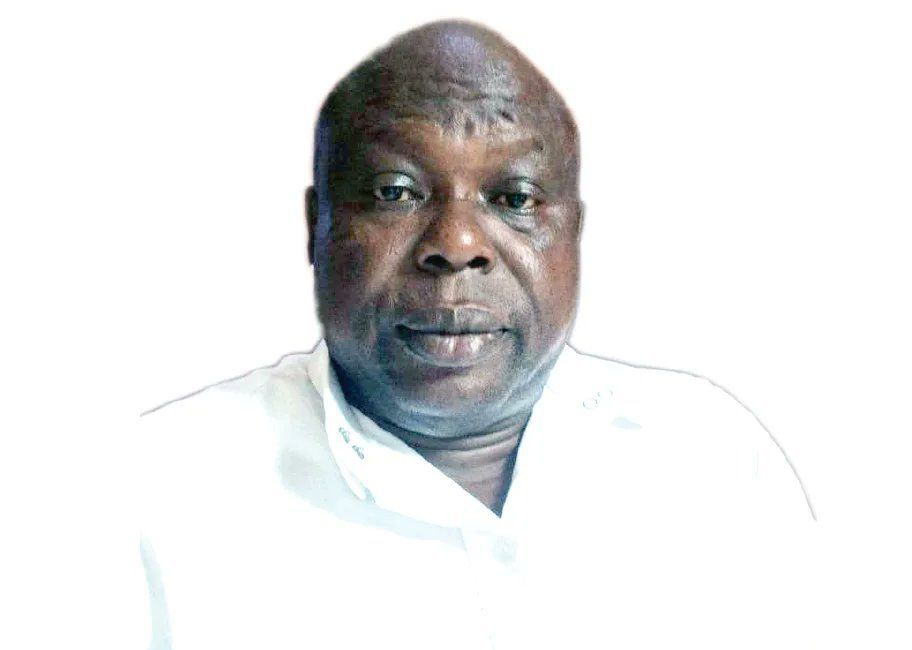
A fresh controversy over the welfare and retirement benefits of Nigerian police officers has emerged following the account of a retired Deputy Superintendent of Police, Isiaka Ayole, who says he received just ₦2.1 million as gratuity after dedicating 34 years and nine months to the Nigeria Police Force.
Ayole’s account has once again brought attention to the longstanding agitation by retired police officers over the Contributory Pension Scheme (CPS), which they have repeatedly accused of leaving many former personnel with inadequate retirement benefits, delayed payments and financial difficulties after decades of service.
In an interview published by Punch on Saturday, November 14, 2026, Ayole disclosed that he retired from the Nigeria Police Force on June 13, 2026, after attaining the mandatory retirement age of 60.
He said he joined the police in 1991 and rose through the ranks from constable to Deputy Superintendent of Police before his retirement.
According to him, his career involved several challenging assignments, including operations against armed robbery and other criminal activities across different parts of the country.
He recalled serving in Oyo, Lagos, Ondo and Zamfara states, among other locations, and participating in several security operations during his years in service.
However, his concern now centres on the retirement benefits he received after spending nearly 35 years in the service of the country.
Ayole explained that he was invited to the police pension office in Eleyele, where he was informed that his gratuity amounted to ₦2.1 million.
The amount, he said, came as a shock because he expected his retirement entitlements to reflect his lengthy years of service.
More troubling to him was the explanation that 24 months of pension contributions were allegedly missing from the records used in calculating his retirement benefits.
The retired officer said he could not understand how two years of contributions could be unaccounted for, considering that police officers are routinely deployed and transferred to different locations as part of their official responsibilities.
He explained that refusing a posting could attract disciplinary consequences, making it difficult for officers to understand why periods of their service might not be reflected in their pension contribution records.
Ayole disclosed that he was informed that his pension-related records were with the Integrated Payroll and Personnel Information System (IPPIS), prompting him to submit a formal complaint requesting an explanation for the missing 24 months.
He said he had yet to receive a satisfactory response.
The former DSP also revealed that he eventually signed the documents presented to him despite his dissatisfaction, because he feared that refusing to sign could further delay the payment of his retirement benefits.
He appealed to President Bola Ahmed Tinubu, the Inspector-General of Police and the Director-General of the National Pension Commission (PenCom) to investigate his case and ensure that his complete retirement entitlements are accounted for.
Ayole said he was not asking for special treatment but wanted an explanation of what happened to the contributions he believed should have been credited to his retirement account.
His account is coming against the background of years of protests and complaints by retired police officers across Nigeria over the contributory pension system.
YEARS OF AGITATION OVER POLICE PENSION SCHEME
The controversy surrounding police pensions is not new.
For several years, retired officers operating under the Contributory Pension Scheme have demanded that the Federal Government withdraw the Nigeria Police Force from the arrangement and establish a separate pension structure for police personnel.
The agitation is largely driven by complaints that the retirement benefits received by some former officers are insufficient to meet their basic needs after decades of service.
Retirees have also questioned the suitability of the contributory system for police personnel, considering the risks, operational demands and peculiar conditions associated with policing.
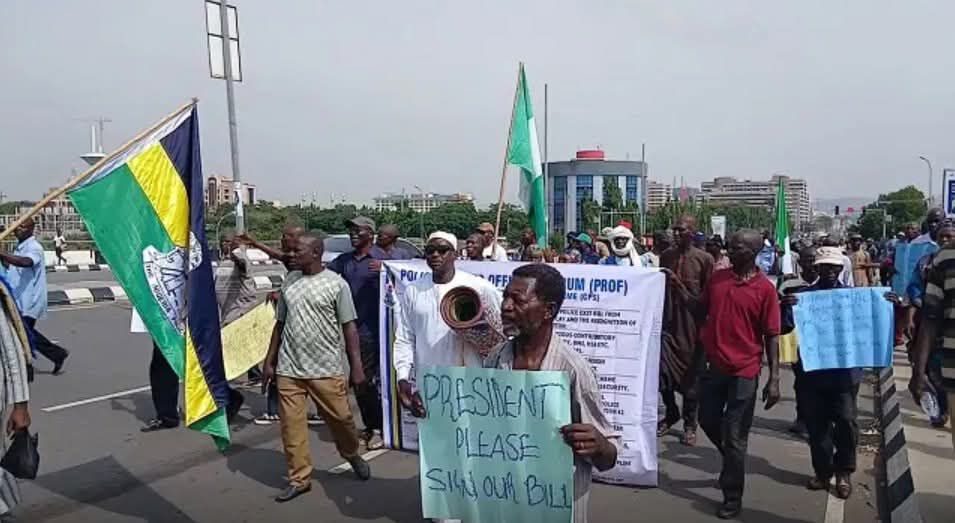
In May 2024, retired police officers stormed the National Assembly in Abuja to protest what they described as inadequate pension payments and difficulties associated with the contributory scheme.
The protesters demanded the establishment of a dedicated Nigeria Police Pension Board and called for the migration of police personnel to the Defined Benefit Scheme.
Christopher Effiong, a retired Superintendent of Police and one of the coordinators of the agitation, said officers had been campaigning for years to be placed under a pension arrangement that would guarantee more predictable retirement benefits.
The retirees argued that many of them enlisted into the police under expectations different from the present pension arrangement and should not be left struggling after years of service.
The demonstration was part of a series of protests through which retired officers sought legislative and executive intervention.
RETIRED OFFICERS STAGE FRESH PROTESTS IN 2025

The agitation intensified in July 2025 when retired police officers staged protests at the National Assembly and the Force Headquarters in Abuja.
The protesters called for the immediate removal of the Nigeria Police Force from the Contributory Pension Scheme, insisting that the existing arrangement had failed to provide adequate retirement security for many former personnel.
Some of the retirees, who had served for more than three decades, complained about low monthly pension payments and inadequate lump-sum benefits.
The then Inspector-General of Police, Kayode Egbetokun, addressed the protesters and assured them that their welfare concerns would receive attention.
The police leadership also indicated that it was engaging relevant authorities and the National Assembly over the proposed pension reforms.
However, the retirees maintained that adjustments to the existing arrangement would not address their fundamental concerns, insisting on a complete exit from the scheme.
By October 2025, the retired officers were threatening to resume nationwide demonstrations after expressing frustration over the pace of government intervention.
In an interview with Punch, one of the leaders of the aggrieved retirees, retired CSP Mannir Lawal, said the officers were dissatisfied with the delay in implementing their demand.
The retirees argued that the military, Department of State Services and other security agencies operated different pension arrangements and questioned why police personnel should remain under the contributory scheme.
PENCOM PROPOSES 75 PER CENT OF FINAL SALARY AS MONTHLY PENSION

Amid the controversy, the National Pension Commission proposed significant adjustments to the retirement benefits of police personnel.
In August 2025, PenCom Director-General, Omolola Oloworaran, called on the Federal Government to increase its pension contribution for police officers from 10 per cent to 20 per cent.
She also proposed that monthly pension payments for retired police officers should be increased to 75 per cent of their final salaries before retirement.
The proposals followed growing protests by retired police officers and discussions with the police leadership.
Other recommendations included introducing a dedicated health insurance arrangement for retired officers, expanding the Retirement Resettlement Fund and reviewing the overall pension structure to better reflect the peculiar demands of police service.
PenCom maintained that the identified challenges could be addressed through reforms within the existing contributory framework, rather than necessarily withdrawing the police from the scheme.
This position highlighted an important difference between the pension regulator and the retired officers: while PenCom advocated improvements to the existing system, the protesters insisted that a complete withdrawal was necessary.
TINUBU ORDERS PENSION INCREASE AND FREE HEALTHCARE FOR LOW-INCOME RETIREES

On August 6, 2025, President Bola Tinubu directed the National Pension Commission to expedite the implementation of free healthcare access for low-income retirees under the Contributory Pension Scheme.
The President also called for the prompt implementation of overdue pension increases and a minimum pension guarantee to protect vulnerable pensioners.
According to a statement issued by the State House, Tinubu gave the directives after receiving a briefing from PenCom Director-General Omolola Oloworaran.
The President specifically mandated the pension regulator to urgently resolve the longstanding police pension issue, emphasising that officers who serve and protect the country deserve dignity and peace of mind in retirement.
The directive represented an important government acknowledgement of the pension concerns affecting retired police officers.
However, the subsequent agitation showed that the retirees continued to demand a more fundamental restructuring of their pension arrangements.
NATIONAL ASSEMBLY PASSES POLICE PENSION BOARD BILL
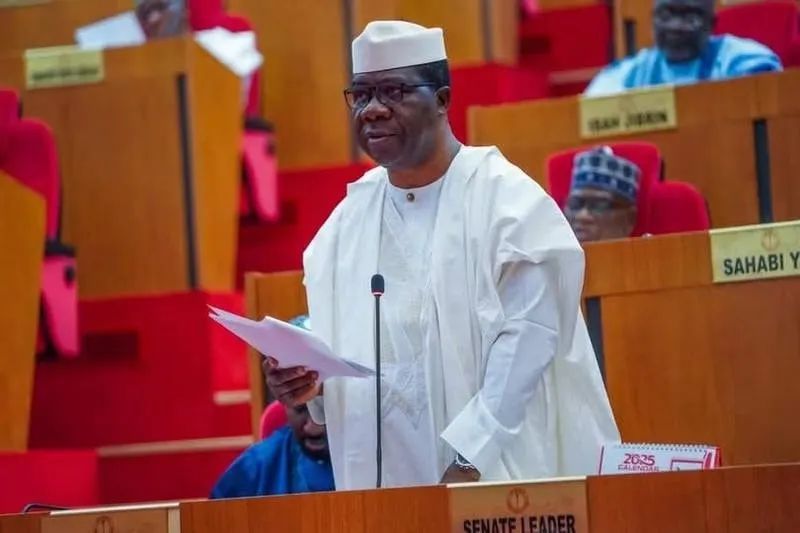
One of the most significant developments in the pension controversy occurred in December 2025, when the National Assembly completed the legislative process on the Nigeria Police Force Pension Board Bill.
The Senate passed the bill on December 4, 2025, after considering the legislation transmitted from the House of Representatives.
The proposed law seeks to establish an independent pension management body dedicated to handling the retirement benefits, gratuities and pension-related matters of serving and retired police personnel.
It also seeks to exempt the Nigeria Police Force from the Contributory Pension Scheme by amending relevant provisions of the pension legislation.
The proposed Police Pension Board is intended to provide a separate administrative structure for managing police retirement benefits.
The legislation followed years of agitation by police retirees, who argued that their welfare should be managed under an arrangement comparable to those applicable to other major security institutions.
Following its passage by both chambers, the harmonised bill was expected to be transmitted to President Tinubu for presidential assent.
RETIRED OFFICERS BLOCK PRESIDENTIAL VILLA GATE IN APRIL 2026
Despite the legislative development, retired police officers returned to the streets in April 2026 to demand presidential action.
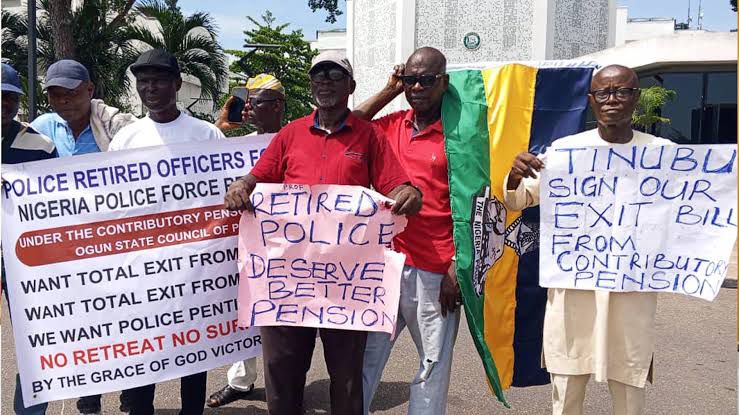
On April 20, 2026, members of the Police Retired Officers Forum of Nigeria staged a protest in Abuja, marching towards the Presidential Villa and demanding that President Tinubu sign the Police Exit Bill.
The protesters carried Nigerian and police flags as well as placards expressing their dissatisfaction with the existing pension arrangement.
They also blocked Gate 8 leading to the Presidential Villa, disrupting vehicular movement while demanding an opportunity to meet the President.
The group’s National Coordinator, retired CSP Raphael Irowainu, said the bill had been passed by the National Assembly on December 4, 2025, and transmitted to the President on March 16, 2026.
He maintained that the police should be removed from the Contributory Pension Scheme and transferred to a Defined Benefit Scheme.
The protesters also demanded the establishment of a Police Pension Board and payment of outstanding pension rights and arrears owed to retired personnel.
Some of the retirees described the financial conditions of former officers as unbearable.
One retired DSP reportedly complained that a former senior police officer could receive as little as ₦30,000 monthly in pension, questioning how such an amount could support a retiree and his family under prevailing economic conditions.
The protesters maintained that their agitation was not simply about increased payments but about a pension structure that would guarantee financial security after retirement.
OVER 30,000 RETIRED OFFICERS GIVE TINUBU ULTIMATUM

In June 2026, the Police Retired Officers Forum of Nigeria intensified its campaign, claiming to represent more than 30,000 retired police officers across the country.
The group called on President Tinubu to urgently assent to the Police Exit Bill and warned that failure to do so before June 22, 2026, could trigger fresh nationwide protests.
Speaking during a press conference in Akure, Ondo State, Irowainu described the proposed legislation as a national security intervention rather than merely a welfare package.
He said the retirees wanted the complete withdrawal of the police from the Contributory Pension Scheme, migration to the Defined Benefit Scheme, establishment of an independent pension board and settlement of outstanding retirement entitlements.
The group argued that the financial security of retired personnel was directly connected to the morale and welfare of serving officers.
It maintained that officers who spend their working lives protecting citizens should not face uncertainty and financial hardship after leaving the service.
ANOTHER MAJOR CONCERN: ALLEGED DISPARITIES IN PENSION PAYMENTS
Beyond the demand to exit the contributory scheme, retired police officers have also raised concerns about the administration of pension payments and the handling of outstanding entitlements.
In March 2026, retired officers under the Nigerian Union of Retired Police Officers under the Contributory Pension Scheme, through their Kaduna State chapter chairman, retired CSP Mannir M. Lawal, appealed to President Tinubu to sign the Police Exit Bill.
The group raised concerns over the implementation of pension payments, including allegations of selective disbursements and differences in the amounts received by officers of similar ranks who retired around the same period.
The retirees also questioned payments allegedly sent to incorrect Pension Fund Administrators and complained that some officers who had submitted required documents were still awaiting their entitlements.
They further raised concerns about gratuity payments, the 2022 pension increment and the reported discontinuation of a ₦32,000 consequential adjustment in December 2025.
The group also questioned aspects of a reported ₦758 billion pension disbursement, alleging that some eligible retirees had not received payments while others had.
These claims require examination by the relevant pension authorities, particularly to establish the status of individual beneficiaries, the payment records and any outstanding obligations.
WHAT IS THE DIFFERENCE BETWEEN THE TWO PENSION SYSTEMS?
The disagreement surrounding police pensions centres largely on the difference between the Contributory Pension Scheme and the Defined Benefit Scheme.
Under the Contributory Pension Scheme, both the employee and employer make contributions into an individual Retirement Savings Account managed by a licensed Pension Fund Administrator.
The accumulated contributions and investment returns determine the retirement benefits available to the employee, subject to applicable pension regulations.
Under the Defined Benefit Scheme, retirement benefits are generally calculated using an established formula linked to factors such as salary, length of service and applicable pension rules. The government or responsible pension authority bears the obligation of funding the benefits.
Retired police officers campaigning for a change argue that the Defined Benefit arrangement would provide greater retirement security and address what they consider inadequate payments under the existing system.
However, any transition would require clear provisions addressing the funding of accrued pension rights, existing Retirement Savings Accounts, past contributions, retirees already receiving pensions and the financial obligations of government.
AYOLE’S CASE RAISES FRESH QUESTIONS FOR POLICE AUTHORITIES
The account of Isiaka Ayole adds another individual case to the wider national debate.
Unlike the general demand for pension reform, his complaint centres on a specific allegation: that 24 months of pension contributions were not reflected in the records used to calculate his retirement benefits.
The former DSP wants the authorities to explain the discrepancy and establish whether the missing contributions were paid, properly credited or omitted through an administrative error.
His case also raises questions about the coordination of personnel records, payroll deductions, pension remittances and retirement calculations involving the Nigeria Police Force, IPPIS and relevant pension administrators.
If the alleged omissions are confirmed, the appropriate authorities would need to establish responsibility and determine the necessary corrections to his records and benefits.
For now, the 24-month discrepancy remains an allegation raised by Ayole, and a formal explanation from the relevant authorities is necessary.
THE QUESTIONS THE FEDERAL GOVERNMENT MUST ADDRESS
As the debate continues, several important questions remain before the Federal Government and relevant institutions:
Why did a retired DSP who served for 34 years and nine months receive a gratuity of ₦2.1 million?
Were the alleged 24 months of pension contributions deducted but not remitted, or were they omitted from the records for another reason?
How many retired police officers are experiencing similar discrepancies in their pension records?
What is the current status of the Police Exit Bill transmitted to President Tinubu in March 2026?
Will the proposed Police Pension Board address the outstanding entitlements of officers who have already retired under the contributory arrangement?
What measures are being taken to guarantee access to healthcare and adequate monthly income for elderly retired police personnel?
These questions require transparent answers from the police authorities, IPPIS, PenCom and the Federal Government.
For thousands of retired officers, the issue goes beyond a pension policy disagreement. It concerns the financial security of people who spent decades in public service and now depend on their retirement entitlements to meet their daily needs.
Ayole’s appeal has therefore renewed attention on a question that has remained central to the agitation by police retirees: what happens to officers after they have spent the best years of their lives protecting the country?
The Federal Government’s response to the pension concerns, the implementation of the proposed reforms and the investigation of individual complaints will be important in determining whether the longstanding crisis can finally be resolved.