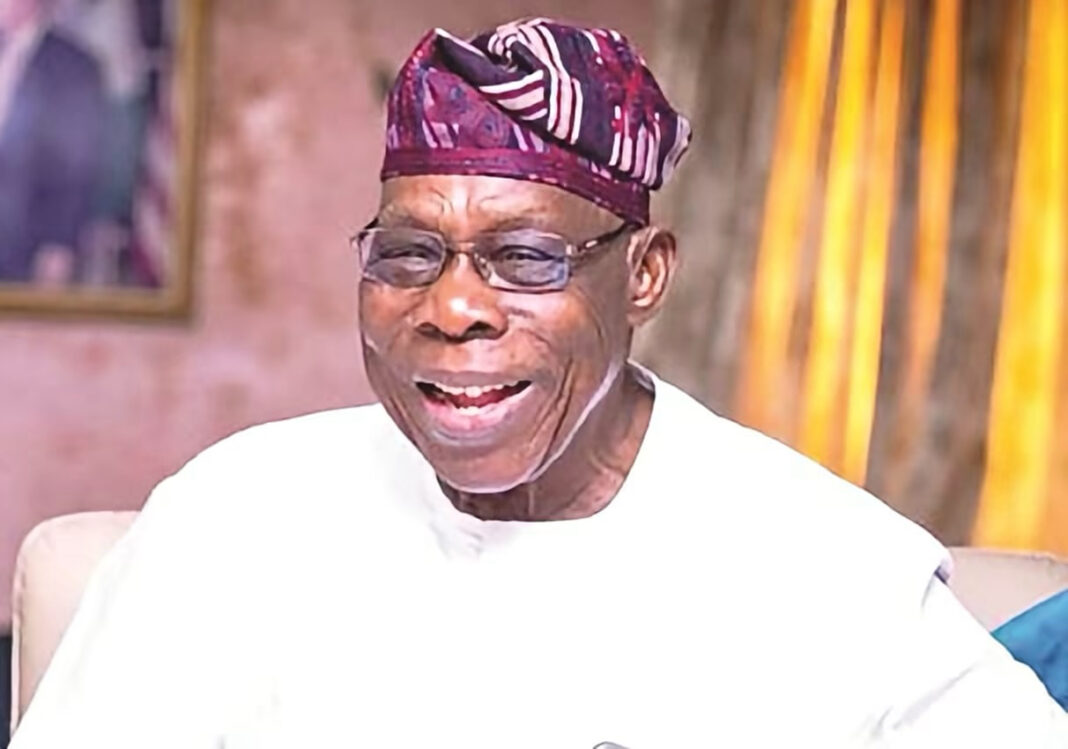

Former Nigerian President Olusegun Obasanjo has revealed how he rejected an offer of political asylum from the United States despite warnings that he would be arrested if he returned to Nigeria during the military regime of late General Sani Abacha.
Obasanjo recounted how his decision to return to Nigeria eventually led to his arrest and imprisonment under the Abacha administration, which ruled the country from November 1993 until the military ruler’s death in June 1998.
The former president disclosed this while speaking at an event organised by the Department of School Library and Media Technology at the University of Ibadan. His account was also featured in an interview published by BBC News Pidgin on Tuesday, November 10, 2026.
Obasanjo explained that after leaving office as military Head of State in 1979, he retired from the Nigerian Army at the age of 42, having attained the rank of a four-star general.
He said he subsequently ventured into farming, which was progressing successfully before the Abacha regime moved against him.
According to him, the American ambassador to Nigeria contacted him while he was travelling and informed him that the United States government had offered him political asylum because of concerns that he would be arrested if he returned home.
Obasanjo said he rejected the offer because he believed he had committed no offence that warranted seeking refuge outside Nigeria.
“Abacha had decided that I must be liquidated; otherwise he would not be able to have his way. I didn’t know that. I was travelling and coming back, and the American ambassador in Nigeria called me and said his country had offered me political asylum because they knew that I would be arrested if I returned home.
“This was difficult for me. I haven’t done anything. What do they want to arrest me for? I don’t want political asylum,” he recalled.
The former president said that upon his return to Nigeria, his passport was seized before he proceeded to his farm.
He recalled that one of his security personnel stopped him at the entrance to the property and informed him that security operatives had surrounded the farm.
According to Obasanjo, a police officer dressed in civilian clothes later approached him and said an Assistant Inspector-General of Police (AIG) wanted him to report to the police.
He said he challenged the officer, insisting that if the AIG wanted to see him, he should come personally rather than send someone to invite him.
Obasanjo eventually drove himself to the police station, where the AIG informed him that he had received instructions to arrest him.
The former president also recounted how former United States President Jimmy Carter intervened on his behalf by appealing to Abacha.
He said the intervention initially resulted in his being placed under house arrest after he had been held at an undisclosed location.
However, Obasanjo said security operatives later arrived at about 1am while he was playing squash and took him away to prison.
“Then President Jimmy Carter came. He pleaded, and then they put me under house arrest. Then they came one day; I was playing squash at about 1am. They came and said they were taking me away. And they took me away, and from there, I went to prison,” he stated.
Obasanjo’s imprisonment was part of the political repression that characterised the Abacha military regime.
He was subsequently released following Abacha’s death in June 1998. He went on to contest the 1999 presidential election and was inaugurated as Nigeria’s civilian president on May 29, 1999.
He served two terms in office, leaving the presidency in May 2007.
The latest revelation provides further insight into Obasanjo’s experience during one of the most turbulent periods of Nigeria’s military history.
IBN News — Fearless, Strong & Reliable